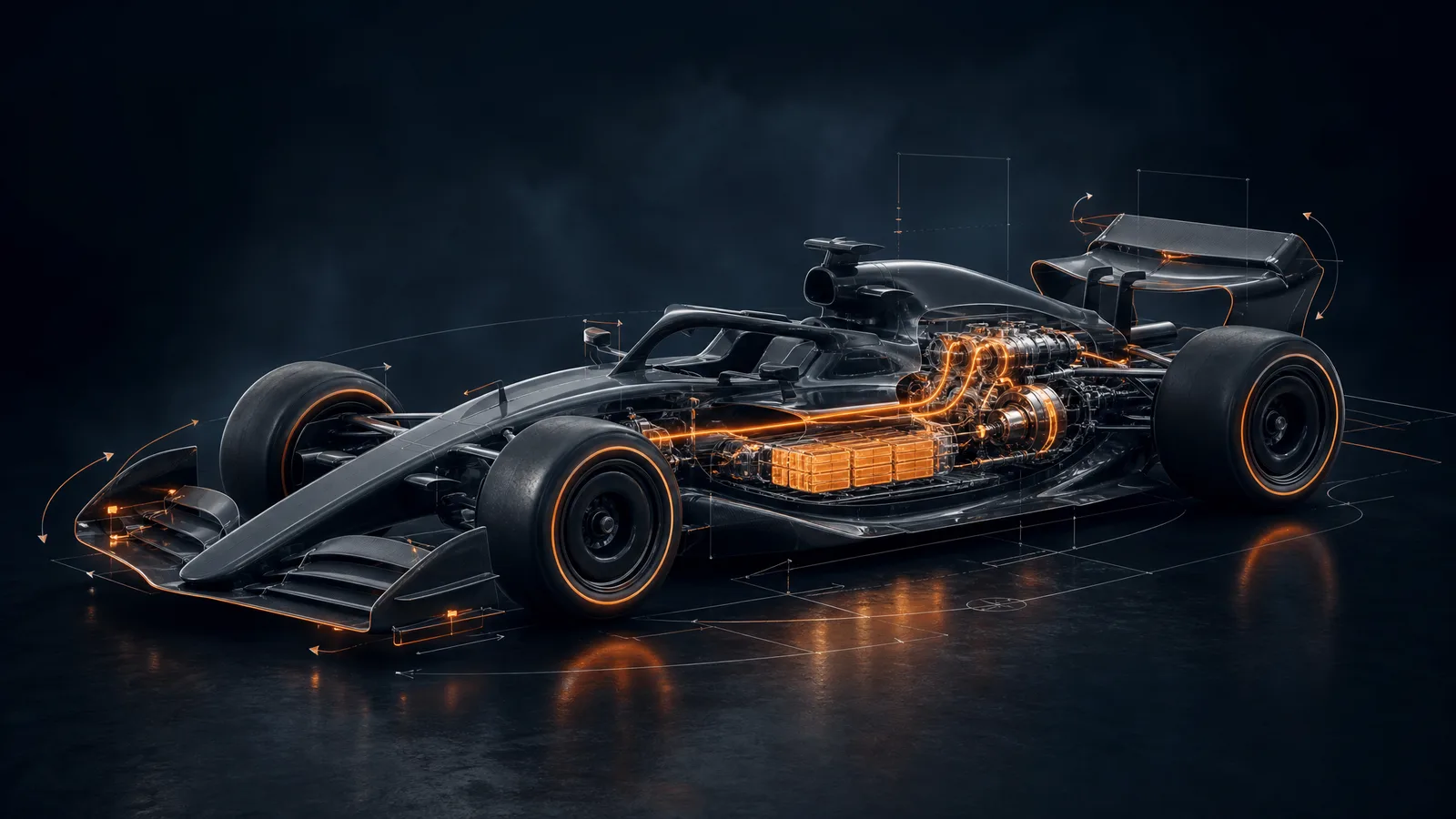
What engine does an F1 car have?
Under the Formula 1 rules it isn’t simply an “engine” but a power unit. It is made up of the internal combustion engine, the turbocharger, the MGU-K motor-generator, the battery and the control electronics. Under the regulations, only the engine and the MGU-K may drive the car and charge the battery.
| Component | What it is | Main limits in 2026 |
|---|---|---|
| Internal combustion engine | A four-stroke 1.6-litre V6 with a 90° vee angle and four valves per cylinder | 80 mm bore, compression ratio no higher than 16.0 |
| Turbocharger | A single compressor and a single turbine on a common shaft | Up to 150,000 rpm, intake pressure below 4.8 bar, at least 12 kg |
| MGU-K | An electric motor-generator permanently connected to the crankshaft | Up to 350 kW and 500 Nm |
| Battery | An energy store with its own management system | State of charge on track may vary by no more than 4 MJ; at least 35 kg |
How much horsepower does an F1 car have?
At peak, about 750 kW, or roughly 1,020 hp. That is our own calculation, adding up the two parts. By the FIA’s estimate, the internal combustion engine produces about 400 kW, or roughly 544 hp, and the electric motor up to 350 kW, roughly 476 hp. We convert using metric horsepower (PS): 1 kW is about 1.36 hp. In imperial horsepower the total is just over 1,000 hp.
The regulations don’t cap the engine’s power directly. What is limited is the fuel energy flow — more on that below, in the fuel section. The electric motor’s power depends on speed: it delivers the full 350 kW up to 290 km/h, less above that, and nothing from 345 km/h. In Overtake Mode, full power lasts up to 337.5 km/h, and the motor keeps pushing up to 355 km/h. These are the general limits in the regulations: for particular circuits and sections, the FIA can set stricter ones.
- Without Overtake Mode
- In Overtake Mode
So above 345 km/h without Overtake Mode, the car is driven by the internal combustion engine alone. How this has affected top speeds is explained in the top speed article.
How does the hybrid work?
The MGU-K works both ways. Under braking and at part throttle it acts as a generator and charges the battery, and under acceleration it acts as a motor and sends energy to the crankshaft. It is permanently connected to the crankshaft, with a fixed gear ratio.
Energy is budgeted lap by lap:
- the battery can be recharged by no more than 8.5 MJ per lap — according to the FIA, braking can recover twice as much energy as before 2026;
- at circuits where that much can’t be harvested, the FIA can lower the limit to 7 MJ;
- the battery’s state of charge on track can vary by no more than 4 MJ;
- in Overtake Mode, up to 0.5 MJ more can be harvested on top of the limit.
The second generator, the MGU-H, was removed from the power unit in 2026. Only the turbocharger’s turbine takes energy from the exhaust, and the regulations forbid passing that energy on to other components, the battery included.
The engine is also started through the MGU-K. At a standing start the electric motor may only join in from 50 km/h; below that, only when the FIA electronics call for it.
The battery
The battery cells must be approved by the FIA, and each manufacturer homologates only one cell specification. The battery casing and its contents weigh at least 35 kg. A built-in management system monitors the cells and, if something fails, cuts power or shuts the hybrid system down.
The state of charge on track can vary by no more than 4 MJ, which is about 1.1 kWh. At the full 350 kW, that reserve would be gone in about 11 seconds. Up to 8.5 MJ can be harvested per lap, though — more than that window — so energy has to be both harvested and spent all the way round the lap.
Fuel and energy flow
The engine’s power is limited through the fuel. The fuel energy flow may not exceed 3,000 MJ per hour, or 550 MJ per hour for each cylinder. Below 10,500 rpm the limit is lower still.
Since 2026 the fuel itself has had to be made from advanced sustainable components only. No more than 1% by mass may come from non-sustainable sources, and only as the additive package. There is more in the 2026 regulations article.
Cars may only be fuelled in the team’s garage with the engine switched off, so there is no refuelling at pit stops. Why refuelling was dropped is explained in the pit stop article.
Who makes the engines in 2026?
Five manufacturers build the 2026 power units. Honda have fully returned and work with Aston Martin, Audi are building an engine for the first time, and Red Bull make theirs together with Ford. GM have been approved by the FIA as a supplier from 2029.
| Manufacturer | 2026 engine | Teams |
|---|---|---|
| Mercedes | AMG F1 M17 | Mercedes, McLaren, Williams, Alpine |
| Ferrari | 067/6 | Ferrari, Haas, Cadillac |
| Honda | RA626H | Aston Martin |
| Audi | AFR 26 Hybrid | Audi |
| Red Bull Ford | DM01 | Red Bull, Racing Bulls |
Engine names are from f1db, and suppliers from the FIA entry list. How a works team differs from a customer team is explained in the teams and cars chapter.
How many engines can a driver use in a season?
The number of power unit elements per season is limited: each driver has an allocation for each type. In 2026 the allocation was raised by one element of each type, and under the changes already approved for 2027, the extra element stays for 2027 and 2028.
| Element | Standard allocation | In 2026 |
|---|---|---|
| Internal combustion engine | 3 | 4 |
| Turbocharger | 3 | 4 |
| Exhaust system | 3 | 4 |
| MGU-K | 2 | 3 |
| Battery | 2 | 3 |
| Control electronics | 2 | 3 |
A driver who goes over the allocation gets a grid penalty: ten places for the first extra element of each type, and five for each one after that. The penalties add up.
How the 2026 engine differs from the previous one
Turbocharged 1.6-litre hybrid V6s have powered Formula 1 since 2014; in 2013 the engines were still naturally aspirated 2.4-litre V8s. What changed in 2026 is the balance of power within the unit.
| What | 2014–2025 | 2026 |
|---|---|---|
| Engine | V6, 1.6 litres, turbo | V6, 1.6 litres, turbo |
| Engine power, FIA estimate | 550–560 kW for the 2024 engines | about 400 kW |
| MGU-K electric motor | 120 kW | up to 350 kW |
| MGU-H generator | yes | removed |
| Combined, our conversion to metric hp | about 910–925 hp for the 2024 engines | about 1,020 hp |
The other changes of 2026 — wings, car size and weight — are covered in the regulations article, and how the car itself is built in the 2026 car article.
FAQ
How much horsepower does an F1 car have?
By our conversion, about 1,020 metric horsepower at peak, or 750 kW: the internal combustion engine produces about 400 kW (an FIA estimate) and the electric motor up to 350 kW. Without Overtake Mode, the electric motor’s full power is available up to 290 km/h.
What size is an F1 engine?
1.6 litres, or 1,600 cc. It is a turbocharged V6: six cylinders at a 90° angle, each with two intake and two exhaust valves.
Who makes F1 engines?
In 2026, Mercedes, Ferrari, Honda, Audi, and Red Bull together with Ford. Mercedes supply four teams, Ferrari three, Red Bull Ford two, and Honda and Audi one each.
What engine does Red Bull use?
Their own, built together with Ford: in the f1db database it is called the Red Bull Ford DM01. Racing Bulls use the same engine.
How many engines can a driver use in a season?
In 2026, four internal combustion engines per driver, and four turbochargers. MGU-Ks and batteries, three each. The first extra element costs ten grid places, and each one after that five.
What is the MGU-K?
A motor-generator connected to the crankshaft. Under braking it charges the battery, and under acceleration it helps the engine — since 2026 with up to 350 kW.
How does the battery work in F1?
It stores the energy the MGU-K harvests under braking and at part throttle, and releases it under acceleration. Up to 8.5 MJ can be harvested per lap, and the charge on track varies by no more than 4 MJ, about 1.1 kWh.
Sources
- FIA 2026 F1 Regulations, Section C (Technical), Art. C5 and C16, Issue 20, 5 August 2026
- FIA 2026 F1 Regulations, Section B (Sporting), Art. B1.5.9, B7.2 and B8.2, Issue 08, 5 August 2026
- FIA: F1’s new era — everything you need to know about the 2026 rules, 17 December 2025
- FIA: the Formula 1 regulations for 2026 unveiled, 6 June 2024
- FIA entry list, 2026 Azerbaijan Grand Prix, document 12, 24 September 2026
- f1db, the Formula 1 results database (CC BY 4.0)