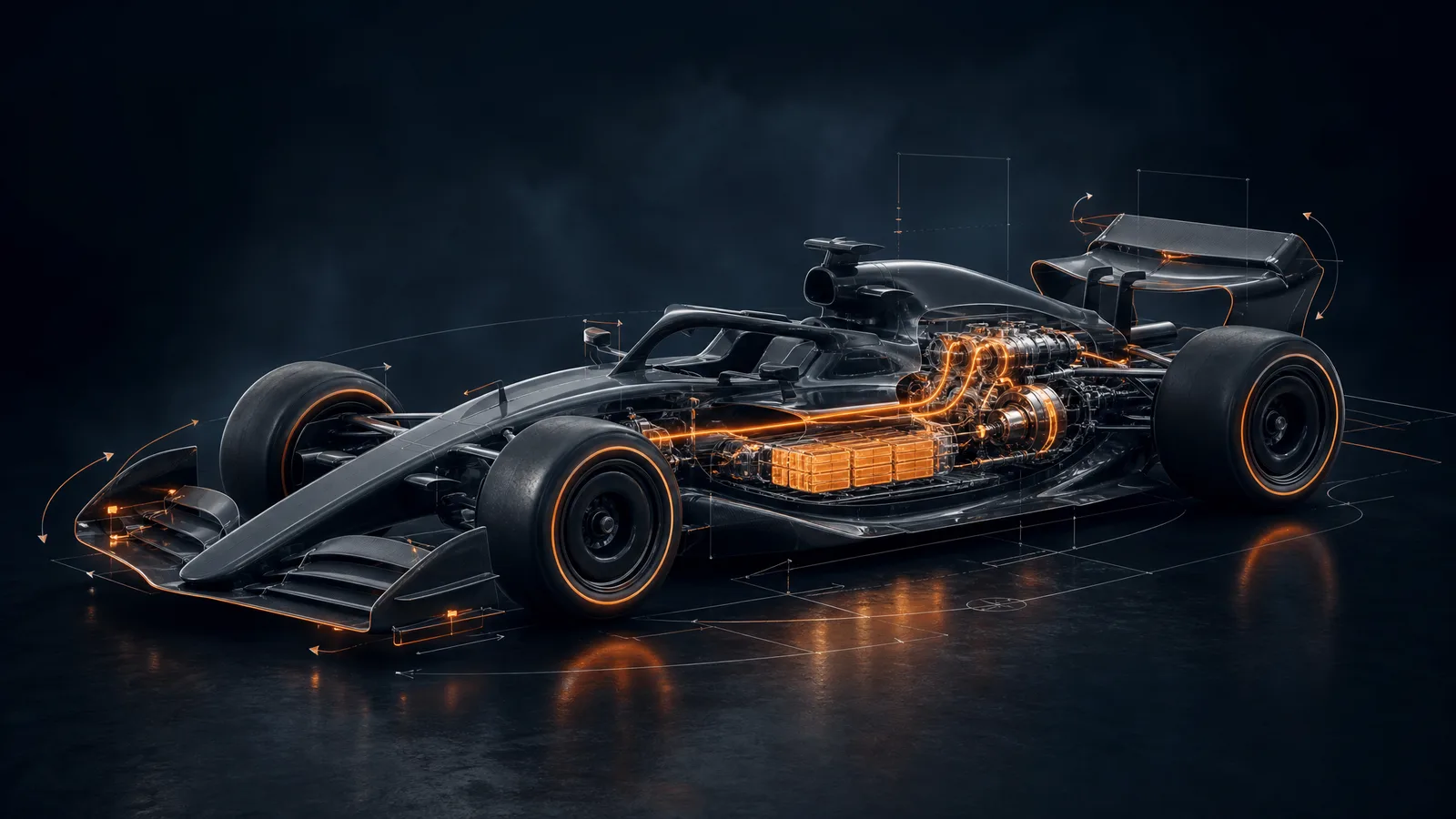
2026 car specifications
The key facts about the 2026 car, from the FIA technical regulations (Issue 20, 5 August 2026) and the FIA’s announcements on the new rules.
| Specification | Value |
|---|---|
| Wheelbase | no more than 3,400 mm |
| Width | 1,900 mm |
| Minimum weight | 724 kg plus tyres; 726 kg plus tyres in qualifying |
| Power unit | 1.6-litre turbocharged V6 and an MGU-K electric motor of up to 350 kW |
| Power unit weight | at least 185 kg |
| Drive | rear wheels only |
| Gearbox | 8 forward gears and reverse, no CVT |
| Wings | moving front and rear wings, two positions, switching in up to 0.4 s |
| Brake discs | up to 34 mm thick; 325–345 mm at the front, 260–280 mm at the rear |
| Wheels | 18-inch, with magnesium alloy rims |
| Driver aids | traction control and ABS are banned |
How much does an F1 car weigh?
At least 724 kg plus the weight of the tyres, and at least 726 kg plus tyres in qualifying and Sprint Qualifying. That includes the driver but not the fuel. The driver and ballast together must weigh at least 82 kg: a lighter driver makes up the difference with ballast.
The tyres are counted at their nominal weight: the supplier weighs 50 new dry tyres for each axle and publishes the average before the season. If a heat hazard is declared for a race or sprint, the minimum weight goes up by another 5 kg — an allowance for the driver’s cooling system.
By the FIA’s estimate, the 2026 cars are about 30 kg lighter than their predecessors.
Dimensions: shorter and narrower
The wheelbase is no more than 3,400 mm, 200 mm less than in 2022–2025. The width is 1,900 mm instead of 2,000, the floor is 150 mm narrower and the front wing 100 mm narrower.
This is the FIA’s Nimble Car Concept: to reverse the trend towards ever bigger and heavier cars and make them noticeably smaller, lighter and more agile. The other rule changes are covered in the 2026 regulations article.
Aerodynamics: moving wings
In 2026 both wings became movable. The front wing has a moving two-element flap, and the rear wing has three elements with a moving flap. The beam wing below the rear wing, used on the 2022–2025 cars, has been removed.
The moving elements are controlled only by the FIA electronics and have two positions:
- for corners — the normal position, with high downforce;
- for straights — the flaps reduce their angle of attack, and drag drops.
Switching takes no more than 0.4 seconds. If the system fails, the wing returns to its corner position by itself. The straight position is allowed only when the car is stationary or inside the zones the FIA marks out at each circuit. This is Straight Mode, which replaced DRS. How the zones work is explained in the regulations article.
By the FIA’s estimate, the 2026 cars have up to 30% less downforce than before, and about 55% less drag.
Power unit
The car has a 1.6-litre turbocharged V6 and an MGU-K motor-generator of up to 350 kW. Together with the battery and electronics, they make up the power unit, which weighs at least 185 kg. How it works, how much horsepower it has and who makes the engines is explained in the engine article.
Gearbox, brakes and wheels
There are eight forward gears, plus reverse. CVTs and automatic gear changes are banned: the driver changes gear. Only the rear wheels are driven. Traction control is banned, as is any warning to the driver about wheelspin.
The brakes have one disc per wheel: up to 34 mm thick, 325–345 mm in diameter at the front and 260–280 mm at the rear. Systems that stop the wheels locking, such as ABS, are banned.
The wheels are still 18-inch, with magnesium alloy rims. Tyres, their compounds and the rules for using them are covered in the tyres article.
Safety
The driver is protected by two roll structures in case the car turns over. The top of the main one must withstand hitting the ground with a load of 20g. The second one is the halo.
The protection requirements went up in 2026:
- loads on the main roll structure are 20g instead of 16g, and test loads 167 kN instead of 141;
- the front impact structure now has two stages, so that the nose doesn’t break off right at the monocoque;
- side protection around the fuel tank has more than doubled;
- the lights on the rear wing endplates are brighter, and two new side lights show the state of the hybrid system on a car that has stopped on track.
The regulations also require three rear lights — one in the centre and two on the rear wing endplates — plus a cockpit fire extinguishing system, two mirrors and a driver drinks system holding 1–1.5 litres.
What are the teams’ cars called?
Each team builds its own chassis and gives the car a model name. It can take the power unit from a manufacturer — there is more in the teams and cars chapter. The FIA entry list records a car by its constructor and engine, as in McLaren Mercedes or Cadillac Ferrari. If the chassis and engine are the same make, it is a single name, such as Ferrari or Audi.
| Team | 2026 car | Constructor in FIA documents |
|---|---|---|
| McLaren | MCL40 | McLaren Mercedes |
| Mercedes | F1 W17 | Mercedes |
| Red Bull | RB22 | Red Bull Racing Red Bull Ford |
| Ferrari | SF-26 | Ferrari |
| Williams | FW48 | Atlassian Williams Mercedes |
| Racing Bulls | VCARB 03 | Racing Bulls Red Bull Ford |
| Aston Martin | AMR26 | Aston Martin Aramco Honda |
| Haas | VF-26 | Haas Ferrari |
| Audi | R26 | Audi |
| Alpine | A526 | Alpine Mercedes |
| Cadillac | CA01 | Cadillac Ferrari |
Model names are from the f1db database, and constructors from the FIA entry list for the 2026 Azerbaijan Grand Prix.
How fast is the 2026 car?
The best speed in the 15 races of 2026 run by 29 September is 358.2 km/h (223 mph): Esteban Ocon at the Barcelona-Catalunya Grand Prix, on FIA timing. Why the 2026 cars are slower than their predecessors on the fastest tracks, and what F1’s speed records are, is explained in the top speed article.
FAQ
How much does a 2026 F1 car weigh?
At least 724 kg with the driver, but without tyres or fuel; with tyres, more by their nominal weight. In qualifying the minimum is 2 kg higher: 726 kg plus tyres.
How big is an F1 car?
The wheelbase is no more than 3,400 mm and the width is 1,900 mm. That is 200 mm and 100 mm less than on the 2022–2025 cars.
What are the 2026 F1 cars called?
McLaren MCL40, Mercedes F1 W17, Red Bull RB22, Ferrari SF-26, Williams FW48, Racing Bulls VCARB 03, Aston Martin AMR26, Haas VF-26, Audi R26, Alpine A526 and Cadillac CA01.
Do the 2026 cars have DRS?
No. Instead, both wings move: in the zones marked out by the FIA, the driver switches them to the straight position and drag drops. This is Straight Mode, and every driver can use it.
How many gears does an F1 car have?
Eight forward gears and reverse. Automatic gear changes and CVTs are banned.
Why are the 2026 cars smaller?
The FIA planned it that way: the cars were meant to become smaller, lighter and more agile instead of growing year after year. The wheelbase was cut by 200 mm, the width by 100 mm and the weight by about 30 kg.
What is the top speed of a 2026 F1 car?
The best speed in the 2026 races up to 29 September is 358.2 km/h (223 mph), at the Barcelona-Catalunya Grand Prix. Speeds from previous years and the records are collected in the top speed article.
Sources
- FIA 2026 F1 Regulations, Section C (Technical), Issue 20, 5 August 2026
- FIA: F1’s new era — everything you need to know about the 2026 rules, 17 December 2025
- FIA: the Formula 1 regulations for 2026 unveiled, 6 June 2024
- FIA entry list, 2026 Azerbaijan Grand Prix, document 12, 24 September 2026
- FIA Race Maximum Speeds, 2026 Barcelona-Catalunya Grand Prix
- f1db, the Formula 1 results database (CC BY 4.0)