What changed in 2026
In 2026 Formula 1 changed its engines, the size of its cars and its aerodynamics all at once. The key points are in the table: the 2022–2025 rules on the left, the 2026 rules on the right.
| What | 2022–2025 | 2026 |
|---|---|---|
| Wheelbase | up to 3,600 mm | up to 3,400 mm |
| Width | 2,000 mm | 1,900 mm |
| Minimum weight | about 30 kg more | 724 kg plus tyres, 726 kg in qualifying |
| Internal combustion engine | 550–560 kW | about 400 kW |
| Electric motor | 120 kW | up to 350 kW |
| MGU-H generator | yes | removed |
| Moving aerodynamics | DRS — a flap on the rear wing | front and rear wings, Straight Mode |
| Overtaking aid | DRS | Overtake Mode — extra energy |
| Teams | 10 | 11 |
The earlier figures and the power of the internal combustion engine come from the FIA; the 2026 dimensions, weight and electric motor limit are set by the regulations. A short overview of the same changes is in the chapter “What changed in 2026”.
Power unit: almost half electric
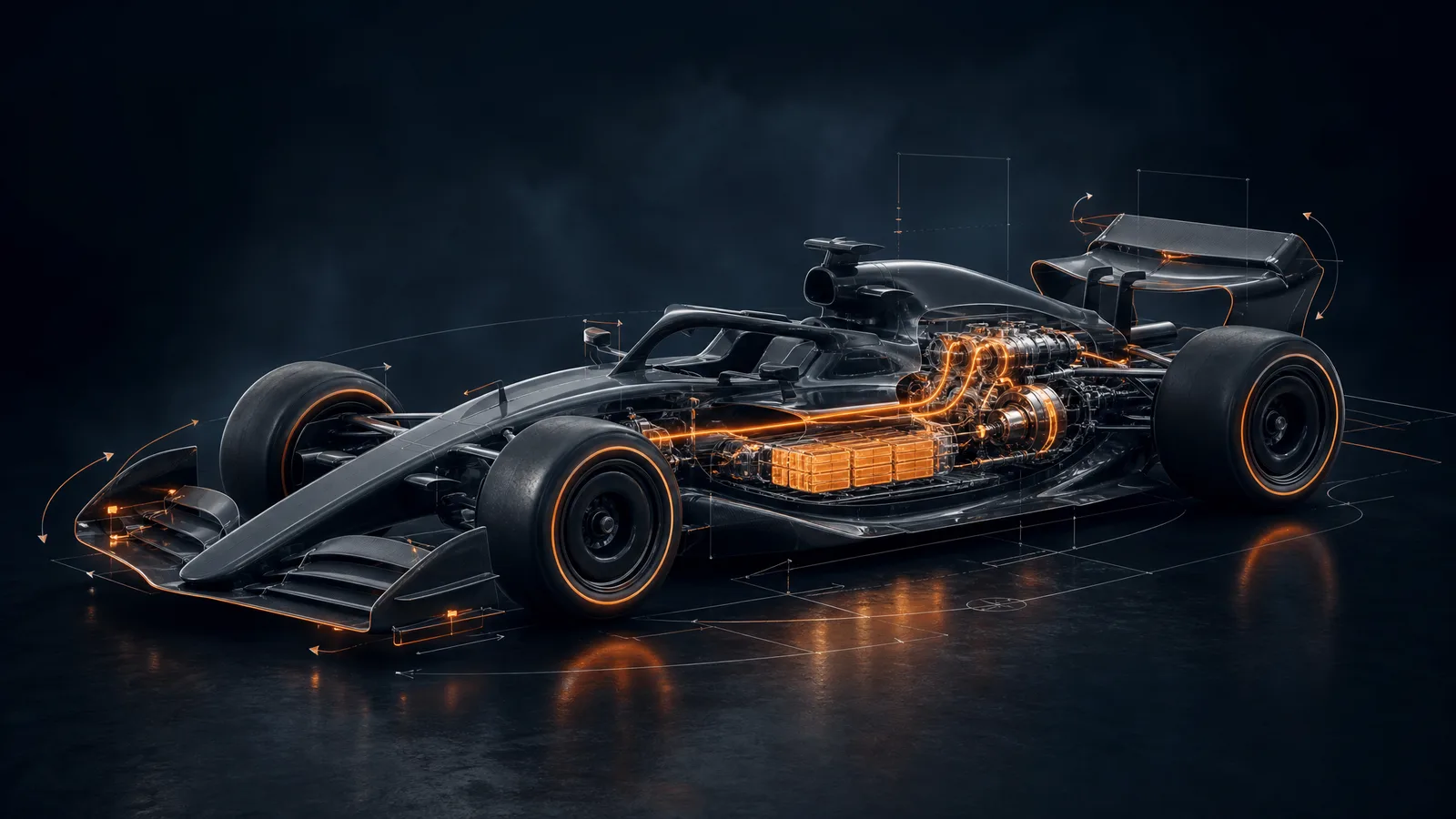
The engine is a 1.6-litre turbocharged V6, but the power is now split almost evenly. According to the FIA, the internal combustion engine produces about 400 kW and the electric motor up to 350 kW — almost three times as much as before.
Only the engine and the MGU-K — the motor-generator linked to the crankshaft — can now drive the car and charge the battery. The second generator, the MGU-H, has been removed from the power unit.
Energy has to be budgeted. The battery can be recharged by no more than 8.5 MJ per lap, and at some circuits the FIA lowers that limit to 7. The battery’s state of charge on track can vary by no more than 4 MJ.
The electric motor’s output depends on speed. Without Overtake Mode, the full 350 kW is available up to 290 km/h; above that the power tapers off and reaches zero at 345 km/h. With Overtake Mode, full power lasts up to 337.5 km/h, and the motor keeps pushing up to 355 km/h. These are the general curves in the regulations: the FIA can adjust them for a particular circuit.
Fuel
From 2026 every car runs on fuel made from advanced sustainable components. They come from non-food biomass, municipal waste or renewable feedstock of non-biological origin. Components from conventional sources can make up no more than 1% of the fuel by mass, and only as the additive package.
How many power units per season
The standard allocation per driver is three each of the engine, turbocharger and exhaust system, and two each of the MGU-K, battery and control electronics. In 2026 drivers get one more of each element. The first extra element of each type costs a ten-place grid penalty, and each one after that five places.
Smaller, lighter cars
The 2026 cars are shorter and narrower. The wheelbase is no more than 3,400 mm, 200 mm less than before, the width is 1,900 mm instead of 2,000, and the floor is 150 mm narrower. The wheels are still 18 inches.
The minimum weight is 724 kg without tyres, plus the nominal weight of a set of dry tyres; in qualifying and Sprint Qualifying the limit is 2 kg higher. By the FIA’s estimate, the cars are about 30 kg lighter.
The FIA expected downforce to fall by no more than 30%, and drag by about 55%.
Straight Mode instead of DRS
DRS, which opened a flap on the rear wing on the straights for 15 seasons, has been scrapped. Now both the front and the rear wing move. In corners they sit in the normal high-downforce position, and on the straights the driver switches them to Straight Mode: the flaps open and drag drops.
The main difference from DRS is who gets to use it. DRS was only available to a driver less than a second behind the car in front. Straight Mode can be used by any driver in the zones the FIA marks out in advance at each circuit, wherever they are relative to their rivals. As the FIA designed it, the new wings are there first and foremost to save energy.
The FIA gives the teams the zones at least four weeks before the event, and the start of each zone is marked by a board beside the track. If the Race Director declares low-grip conditions, only the front wing may be opened.
Overtake Mode
For attacking there is now Overtake Mode — extra electrical energy for the chasing driver. The track has a detection line: a solid yellow line across the circuit. If a driver crosses it closer than a set gap to the car ahead, the mode switches on at the next marker, the activation line.
The gap is set by the FIA, which itself describes it as one second. The mode gives up to 0.5 MJ of extra energy per lap and lets the electric motor keep pushing up to 355 km/h. If the gap at the next detection line is bigger than the threshold, the mode switches off at the activation line.
At the start, Overtake Mode doesn’t work until the leader first crosses the detection line. It is also off under the safety car, until every car has crossed the line after the safety car has come in. It is switched off in low-grip conditions, and the Race Director can disable it at any time for safety. In practice and qualifying the mode is available whenever it is enabled.
Eleven teams and five engine manufacturers
There are eleven teams in the 2026 championship. Cadillac have joined — the first completely new team since Haas arrived in 2016. The former Sauber team, which raced as Kick Sauber in 2024–2025, has become Audi.
Five manufacturers build power units. Mercedes supply their own team, McLaren, Williams and Alpine; Ferrari supply themselves, Haas and Cadillac. Honda have fully returned and work with Aston Martin, Audi build their own engine, and Red Bull make theirs together with Ford, for Red Bull and Racing Bulls. Cadillac use Ferrari engines for their first seasons, and GM have been approved by the FIA as a supplier from 2029.
How a works team differs from a customer team is explained in the teams and cars chapter.
What it means for racing
Energy now has to be managed over the lap: the charge per lap is limited, and the 2026 power units depend more on electricity.
The FIA has made Overtake Mode the main overtaking aid: everyone uses Straight Mode, but the extra energy only goes to a driver who is within the threshold of a rival at the detection line.
How the other rules work — the weekend, points, flags — is covered in F1 rules explained, and how qualifying works in a separate article.
FAQ
What is Straight Mode in F1?
A setting of the moving wings for the straights: the flaps on the front and rear wings open, and drag drops. From 2026 any driver can use it in the zones marked out by the FIA.
Has DRS been scrapped?
Yes, there has been no DRS since 2026. Its place has been taken by Straight Mode, which everyone can use, and Overtake Mode — extra energy for a driver who is closer than a set gap to the car ahead.
How much power does a 2026 F1 car have?
According to the FIA, the internal combustion engine produces about 400 kW and the electric motor up to 350 kW. Without Overtake Mode, the electric motor’s full power is available up to 290 km/h, and above that it drops.
Which teams are new in 2026?
Cadillac are a completely new team, the first since 2016. Audi grew out of the Sauber team, which was called Kick Sauber in 2024–2025.
What fuel do the cars use in 2026?
Fuel made from advanced sustainable components: non-food biomass, municipal waste or renewable feedstock of non-biological origin. Components from conventional sources make up no more than 1% by mass, and only as additives.
Which issue of the regulations is currently in force?
As of 29 September 2026, Issue 20 of the technical regulations and Issue 08 of the sporting regulations are in force, both dated 5 August 2026. The rules are refined during the season, so the figures in this article have been checked against these issues.
Sources
- FIA 2026 F1 Regulations, Section C (Technical), Issue 20, 5 August 2026
- FIA 2026 F1 Regulations, Section B (Sporting), Issue 08, 5 August 2026
- FIA: F1’s new era — everything you need to know about the 2026 rules, 17 December 2025
- FIA: the Formula 1 regulations for 2026 unveiled, 6 June 2024
- f1db, the Formula 1 results database (CC BY 4.0)