What kinds of tyres does F1 use?
Tyres fall into two groups: for a dry track and for a wet one. Dry tyres are slicks, with a smooth surface and no grooves. On a wet track, drivers use tyres with a tread pattern: intermediates when the asphalt is damp, and full wets when it’s pouring.
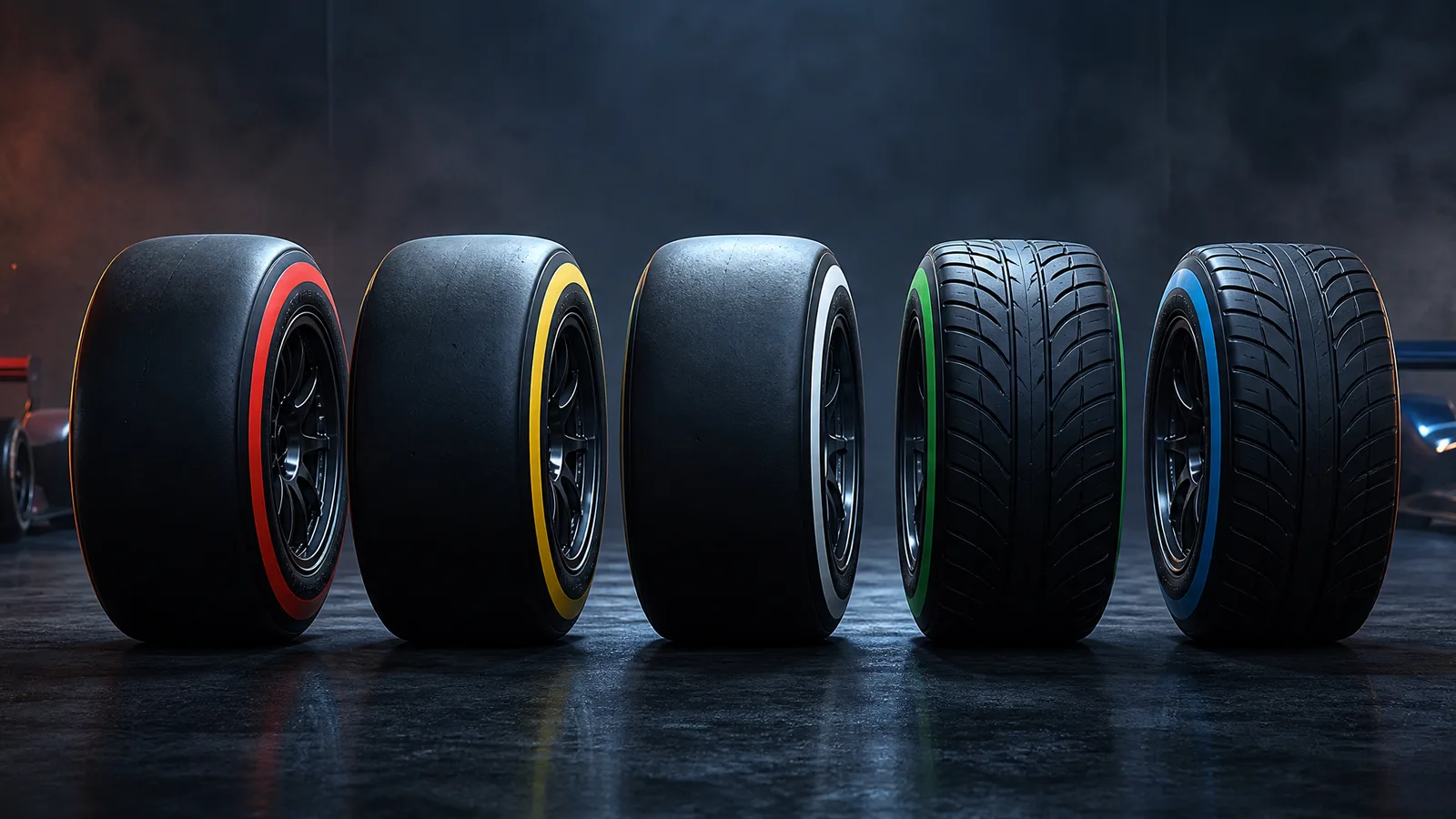
The supplier brings five types to each event: three dry compounds, intermediates and full wets. The regulations require all five to be easy to tell apart on track, so each tyre’s sidewall is marked in its own colour.
- Soft
- Medium
- Hard
- Intermediate
- Full wet
| Tyre | Band colour | When it’s used |
|---|---|---|
| Soft | Red | Dry track: the fastest lap, but it wears out sooner |
| Medium | Yellow | Dry track: a balance between speed and wear |
| Hard | White | Dry track: slower, but lasts a long stint |
| Intermediate | Green | A damp track without puddles, or a drying one |
| Full wet | Blue | Heavy rain, lots of water on the track |
The colours were unchanged for 2026.
The C1–C5 compounds and how they are picked for each event
In 2026 Pirelli has five dry compounds, from the hardest, C1, to the softest, C5. A sixth, C6, was in the 2025 range but was dropped for the new season: in testing, its lap times were barely different from the C5’s.
Three of the five compounds go to each event, and their names are relative: the hardest of the three is called hard, the middle one medium and the softest soft. So the same C3 can be the soft at one circuit and the hard at another. That is how it worked at the first three events of 2026:
Pirelli calls Suzuka one of the toughest circuits of the year for tyres, so it got the three hardest compounds.
The FIA tells the teams which compounds will be used at an event at least two weeks in advance. At the same time it names the compound that must be used in the race — one or two of them — and, at a standard event, the compound for Q3: always the softest of the three. How tyres are shared out in qualifying is covered in the qualifying article.
Some events also get experimental dry tyres. They are tried only in practice on the first day and never make it into qualifying or the race.
How soft tyres differ from hard ones
Soft rubber warms up faster and grips better, but wears out sooner. Hard rubber is slower over a lap, but it copes with heat and loads and lets a driver go longer without stopping.
According to Pirelli, the C1 is designed for circuits with the highest tyre loads, heat and severe conditions, and the C2 for fast, hot circuits with abrasive asphalt. The C3 can play any role — hard, medium or soft. The C4 gets up to working temperature quickly, and the C5 is made for the slowest circuits with smooth asphalt and little wear.
For 2026 the supplier spread the compounds wider and more evenly in lap time, so that teams would have more strategy options.
The way a tyre loses speed over a stint is called degradation. Sometimes the rubber goes off before it wears out. On a cool track the surface tears into small rolls of rubber — that’s graining. When the tyre overheats, bubbles form under the surface — that’s blistering.
Why don’t F1 tyres have tread?
Slicks have no tread so that the rubber makes the best possible contact with the road — that’s Pirelli’s explanation. Tread is needed in the rain: water drains away through the grooves. A smooth tyre can’t clear water on a wet track and can ride up on it like a water ski — that’s aquaplaning. So only intermediates and full wets have tread.
Teams aren’t allowed to modify tyres: the regulations ban cutting them, grooving them or treating them with solvents or softening agents — dry and wet tyres alike. Tyres may be inflated only with air or nitrogen.
Tyres for rain: intermediates and full wets
Intermediates are used on a wet track without standing water, and on asphalt that is starting to dry. Full wets are for heavy rain: their tread clears a lot of water off the track. In 2026 both have the same tread pattern as in 2025.
Lap times show when to switch. In 2020 Pirelli described a general rule: if a lap on slicks gets 10–12% slower than normal, it’s time for intermediates. Once a lap on intermediates is that much slower than their normal time, it’s time for full wets.
Special rules apply in wet weather:
- in practice, intermediates and full wets may be used only once the Race Director has declared the track wet;
- if the formation laps start behind the safety car, full wets are compulsory until the safety car comes into the pits;
- on intermediates and full wets, a car’s rear lights stay on the whole time;
- a driver who used intermediates or full wets in the race is exempt from the two-dry-compounds rule.
How many sets does a driver get per event?
A set is four tyres of the same compound, two front and two rear. At a standard event a driver gets 13 sets of dry tyres, and at a sprint weekend 12.
| Tyres | Standard event | Sprint weekend |
|---|---|---|
| Hard | 2 | 2 |
| Medium | 3 | 4 |
| Soft | 8 | 6 |
| Intermediate | 5 | 6 |
| Full wet | 2 | 2 |
Some dry sets are handed back after practice. At a standard event, a driver keeps one set of the softest compound untouched until Q3 and holds on to two sets of the mandatory race compound until the race. How a sprint weekend works is explained in the race weekend chapter.
The two-compound rule
In a dry race every driver must use at least two different dry compounds, and one of them must be the mandatory race compound the FIA named in advance. Breaking the rule means disqualification. If the race is stopped and never resumed, 30 seconds are added to the offender’s time instead.
The rule doesn’t apply to drivers who used intermediates or full wets in the race. In a sprint it doesn’t exist at all: it is written only for the race.
So in a dry race everyone needs at least one pit stop. The only way round it is to change tyres during a red-flag stoppage, which is allowed. When it pays to change tyres is explained by the undercut and the overcut.
Size, warming and sensors
In 2026 the tyres still fit 18-inch wheels, but they got smaller to suit the new cars. The tread width shrank by 25 mm at the front and 30 mm at the rear, and the overall diameter by 15 mm at the front and 10 mm at the rear.
Before going out, tyres are warmed with electric blankets. A blanket may have no more than three heating zones, and any other way of warming the wheels is banned. On the grid, the blankets are switched off at the five-minute signal before the formation lap.
Every wheel has a pressure and temperature sensor, the same for all cars. Before each Grand Prix, the FIA and the supplier issue instructions on how the tyres must be used at that event, and the teams have to follow them.
Why only Pirelli in F1?
That is how the regulations work: tyres come from a single manufacturer appointed by the FIA. Pirelli became the sole supplier in 2011. In 2023 it won the FIA tender for 2025–2027, and on 11 June 2026 the FIA extended the contract to the 2028 season. Pirelli tyres are also used in Formula 2 and Formula 3.
In the tender, the FIA asked for tyres with a wide working range that overheat less and lose speed more slowly, while leaving room for different strategies.
FAQ
What are F1 tyres called?
Dry tyres are slicks. There are three at each event — hard, medium and soft — and in Pirelli’s 2026 range they are the compounds C1 to C5. For a wet track there are intermediates and full wets.
How many types of tyres are there in F1?
In 2026 the supplier has seven: five dry compounds, intermediates and full wets. Five go to each event: three dry compounds and both rain tyres.
What do the colours on F1 tyres mean?
Red means soft, yellow medium, white hard, green intermediate and blue full wet. The colour of a dry tyre shows how soft it is at that event, not its compound number.
Why don’t F1 tyres have tread?
So that the rubber makes the best possible contact with the asphalt, according to Pirelli. Grooves are there to clear water, so only intermediates and full wets have them.
When are intermediates used?
When the track is wet but has no standing water, or when it is drying after rain. If the rain is heavy and there is a lot of water, drivers switch to full wets.
How many sets of tyres does a driver get per event?
At a standard event, 13 sets of dry tyres, five of intermediates and two of full wets. At a sprint weekend, 12 dry sets, six intermediate and two full wet.
Why does F1 only use Pirelli?
The FIA regulations provide for a single tyre supplier, chosen by tender. Pirelli has supplied F1 since 2011, and under the current contract it will do so until the end of the 2028 season.
Can a driver finish a dry race without a pit stop?
Not if the race wasn’t stopped: two different dry compounds are required, or the driver is disqualified. The only way to avoid a stop is to change tyres during a red-flag stoppage.
Sources
- FIA 2026 F1 Regulations, Section B (Sporting), Art. B1.5, B5 and B6, Issue 08, 5 August 2026
- FIA 2026 F1 Regulations, Section C (Technical), Art. C10.7–C10.8, Issue 20, 5 August 2026
- FIA 2026 Formula 1 Penalty Guidelines, version 01
- Pirelli: the 2026 F1 tyres, compounds and sizes, 9 December 2025
- Pirelli: the range of compounds for the 2026 season, 24 November 2025
- Pirelli: compounds for the first three Grands Prix of 2026, 15 December 2025
- Pirelli: Formula 1 tyres, the 2026 compounds
- Pirelli: when to switch from slicks to wet tyres in Formula 1, 29 September 2020
- FIA: Pirelli stays Formula 1’s single tyre supplier until 2028, 11 June 2026
- FIA: Pirelli confirmed as tyre supplier for 2025–2027, 10 October 2023