What is a pit stop, and why make one?
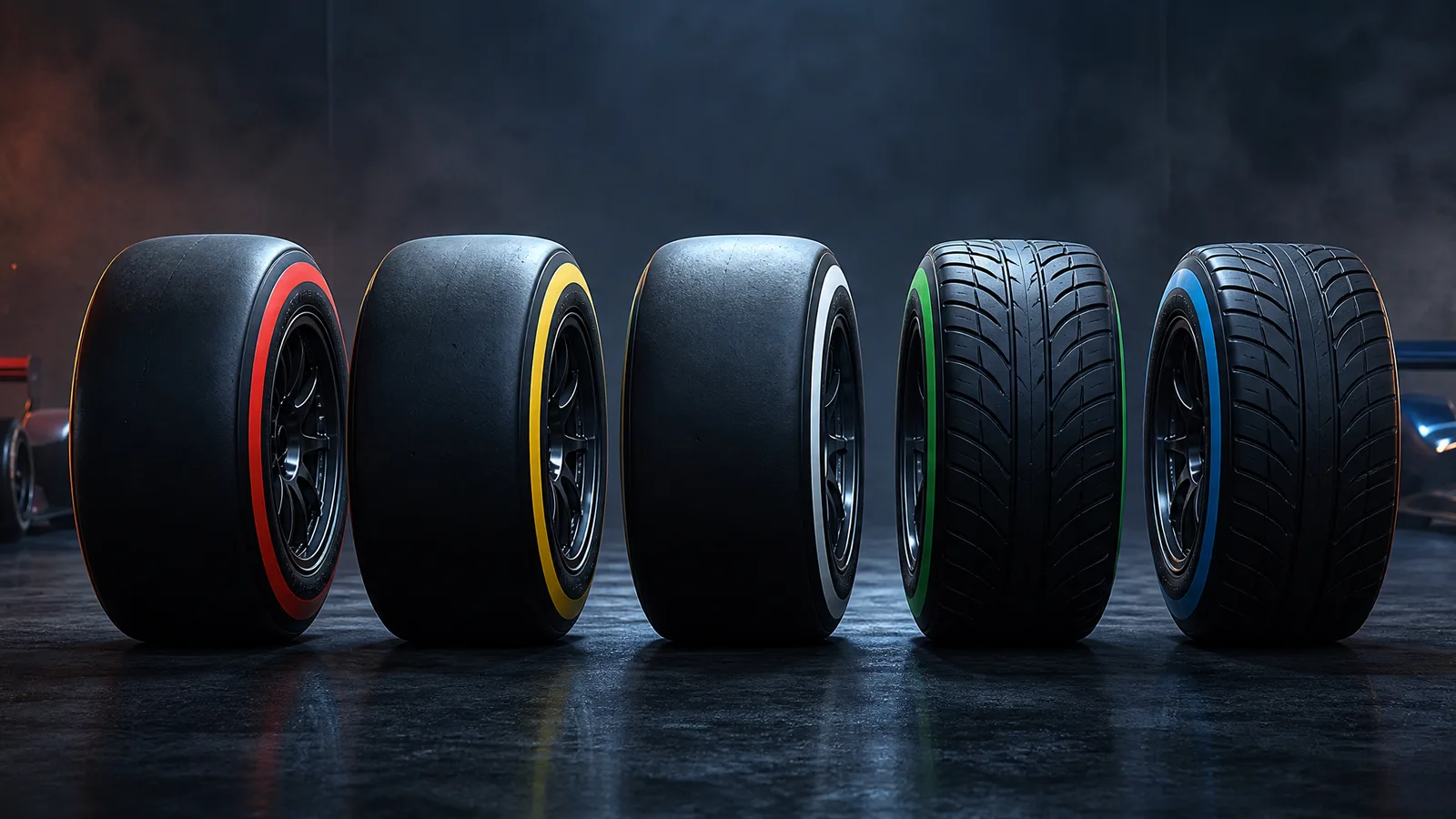
A pit stop is when a car stops at its own spot in the pit lane during a session. The main reason is to change tyres: in a dry race every driver has to use two different compounds, and worn tyres lose speed with every lap. The rule is explained in detail in the tyres article.
Teams also use pit stops to adjust the front wing, and drivers serve 5- and 10-second penalties there.
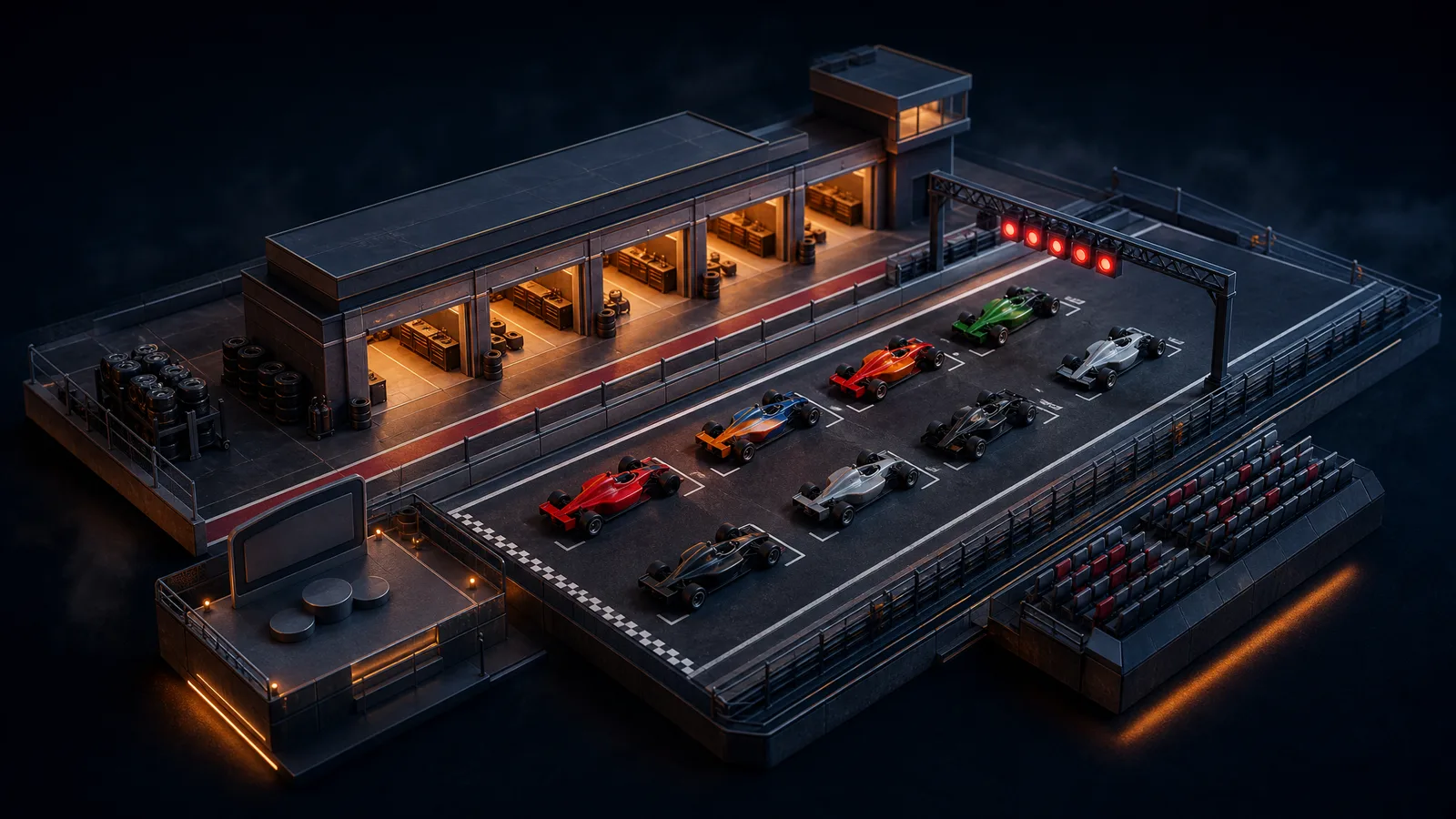
Each team has one place to stop: the FIA allocates it in the pit lane in front of the team’s garage. The team must mount a camera above it that sees the whole car.
How a pit stop works, step by step
- The team calls the driver in on the radio — “Box” — and carries the new wheels out to the pit lane. The tyre blankets are already off: in the race and the sprint, they may not be taken there.
- The driver enters the pit lane and drives at no more than 80 km/h (50 mph): that limit covers the whole pit lane all weekend unless the Race Director changes it.
- The car stops in its spot, and the front and rear jacks lift it — powered lifting devices are banned in the pit lane.
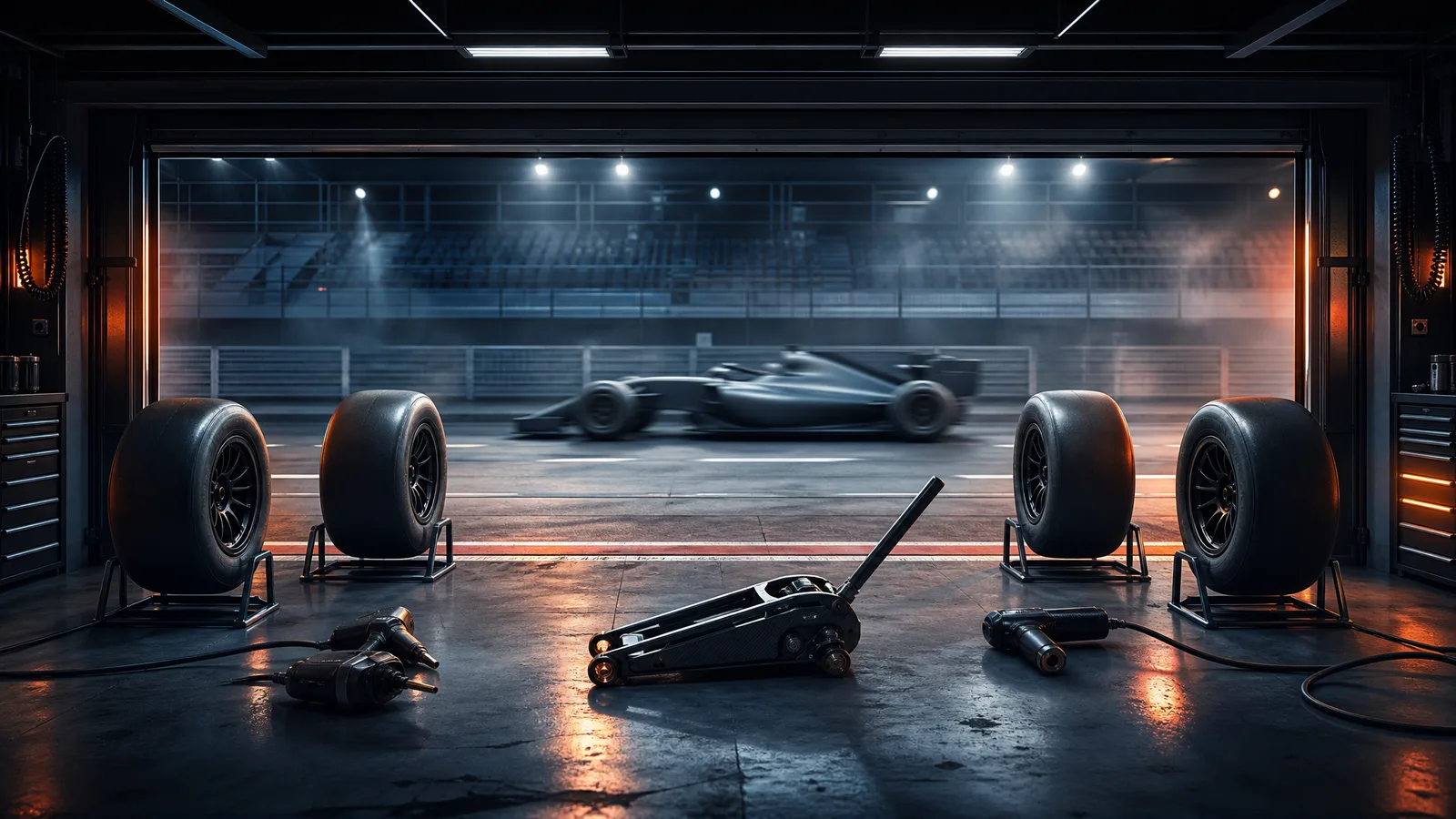
- A wheel gun running on compressed air, nitrogen or electricity undoes each wheel’s single centre nut; the old wheel comes off and the new one goes on.
- A two-stage retention device holds the nut: it stops the nut coming off even if it has worked loose or isn’t fully tightened.
- The mechanics on the wheel guns press their buttons — and a green light comes on for the driver.
- The driver leaves along the pit lane under the same speed limit and rejoins the track on a green signal at the pit exit.
In qualifying, the sprint and the race, everyone working on the car at its pit stop position must wear a helmet and eye protection. A car counts as released once its rear axle has passed the point where its front axle stood.
How long does a pit stop take?
The tyre change itself takes about two seconds. At the first 15 events of 2026, the fastest stop of each event took between 1.99 and 2.44 seconds, according to the Fastest Pit Stop Award on the Formula 1 website. Racing Bulls were quickest of all, in Hungary.
But a visit to the pits takes far longer than the stop itself: the car drives the full length of the pit lane at a limited speed, usually 80 km/h. So the time lost depends on the length of the pit lane: from 18 seconds at Zandvoort to 31 in Madrid.
| Circuit | Season | Time in the pit lane |
|---|---|---|
| Zandvoort | 2025 | 18.0 s |
| Budapest | 2026 | 22.0 s |
| Silverstone | 2026 | 29.6 s |
| Madrid | 2026 | 31.5 s |
The figures come from the FIA pit stop summaries, DURATION column. That is the time in the pit lane including the stop, not just the tyre change: Lindblad’s stop in Hungary shows 21.4 seconds there, although his wheels were changed in 1.99. The table gives the median for each race: half the stops were quicker, half were slower.
The fastest pit stop in history
The record is 1.80 seconds. McLaren set it at the Qatar Grand Prix on 8 October 2023, on Lando Norris’s stop. It is listed by Guinness World Records.
Before that, the record stops belonged to Red Bull with Max Verstappen: 1.88 seconds at the German Grand Prix in 2019, then 1.82 at the Brazilian Grand Prix.
As of the end of September 2026, the record still stands. The best stops of 2024 and 2025 under the same award were 1.90 and 1.91 seconds. At the first 15 events of 2026, the best was Racing Bulls’ stop for Arvid Lindblad in Hungary — 1.99.
How many people change the tyres?
About 23: that is how many people a team has ready for a pit stop, the Formula 1 website wrote in 2019. Each has a job — wheel gun, wheel off, wheel on, front jack. Others adjust the front wing, wipe the rear wing and the driver’s visor, and clear debris out of the sidepods.
At Williams in 2019, each of the 23 people in the crew had one fixed role, and before the season the team practised more than 1,200 stops on a rig.
Besides the jacks and wheel guns, the regulations list other pit stop equipment: a side jack for unusual situations, an overhead gantry supplying air and electricity, and a control system with traffic lights.
Why is there no refuelling in F1?
It has been banned since the 2010 season. In 2026 no fuel may be added or removed from the moment the car leaves the pit lane for its lap to the grid until the finish. Cars are fuelled only in the team’s garage, so each one carries all the fuel for the race from the start.
Pit stops used to be refuelling stops too: cars were refuelled during stops for 16 seasons in a row, from 1994 to 2009. The FIA announced the ban on 12 December 2008, along with other cost-cutting measures for 2010.
Pit lane penalties
Penalties are handed out by the stewards, and the FIA publishes guidelines with the usual penalties for 2026:
| Offence | Practice and qualifying | Race and sprint |
|---|---|---|
| Speeding in the pit lane | Team fine: €100 for every km/h over the limit, up to €1,000 | Up to 6 km/h over: 5 s; 6–15 km/h: drive-through; over 15: 10-second stop-and-go |
| Unsafe release | Team fine | 5 or 10 s, or a drive-through |
| Releasing a car in an unsafe condition | Team fine; in qualifying, up to three grid places | 10-second stop-and-go; if the car retired, a team fine |
A 5- or 10-second penalty is served at the driver’s next pit stop: the car stays still for the set time, and nobody may touch it, by hand or with tools. If the driver doesn’t pit again, the seconds are added to their race time. How the other penalties work is explained in the chapter on flags and penalties.
When is it worth pitting?
Choosing the moment is the strategists’ main job, and they have several options:
- the undercut — pit before a rival and gain time on fresh tyres;
- the overcut — stay out longer while the rival is warming up new tyres;
- a safety car or Virtual Safety Car — everyone is going slowly, so a stop costs less, and during these periods drivers may pit only to change tyres;
- rain — intermediates or full wets, as explained in the tyres article.
FAQ
How long does an F1 pit stop take?
The tyre change itself takes about two seconds: at the first 15 events of 2026 the best stops took between 1.99 and 2.44 seconds. With the drive down the pit lane, the whole visit usually takes 18 to 31 seconds, depending on the circuit.
What is the fastest pit stop in F1 history?
1.80 seconds — McLaren, on Lando Norris’s stop at the Qatar Grand Prix on 8 October 2023. As of the end of September 2026, the record still stands.
How many people change the tyres at a pit stop?
About 23, the Formula 1 website wrote in 2019. They include mechanics on the wheel guns, those who take the wheels off and put them on, the jack operators, and those who adjust the wing and clean the car.
Why was refuelling banned in F1?
The FIA banned it from 2010 as part of a package of cost-cutting measures. From 1994 to 2009 cars were refuelled at pit stops; since the ban, all the fuel for the race goes in before the start.
Is a pit stop mandatory?
In a dry race, yes: every driver has to use two different dry compounds. The exceptions are a driver who used intermediates or full wets, and one who changed tyres during a red-flag stoppage. There is no mandatory pit stop in a sprint.
How many pit stops are there in a race?
In a dry race without a red-flag stoppage, at least one, to use two compounds. How many more depends on tyre wear, safety cars and the weather: the rules don’t limit the number of stops.
What happens if a wheel isn’t fitted properly?
The stewards can treat it as releasing a car in an unsafe condition. In the race that means a 10-second stop-and-go, and if the car retired because of it, the team can be fined.
What is the pit lane speed limit?
80 km/h all weekend, unless the Race Director sets a different limit. Speeding in the race costs anything from a five-second penalty to a 10-second stop-and-go.
Sources
- FIA 2026 F1 Regulations, Section B (Sporting), Art. B1.5, B1.6, B1.9 and B5, Issue 08, 5 August 2026
- FIA 2026 F1 Regulations, Section C (Technical), Art. C10.9 and Appendix C, Issue 20, 5 August 2026
- FIA 2026 Formula 1 Penalty Guidelines, version 01
- FIA Race Pit Stop Summary, 2025 Dutch Grand Prix
- FIA Race Pit Stop Summary, 2026 Hungarian Grand Prix
- FIA Race Pit Stop Summary, 2026 British Grand Prix
- FIA Race Pit Stop Summary, 2026 Spanish Grand Prix (Madrid)
- Formula 1: Fastest Pit Stop Award, 2026 results by event
- Formula 1: the fastest pit stop of the 2026 Hungarian Grand Prix, 27 July 2026
- Formula 1: Fastest Pit Stop Award, 2024 results
- Formula 1: Fastest Pit Stop Award, 2025 results
- Guinness World Records: fastest Formula One pit stop
- Formula 1: the 1.80-second record, McLaren and Norris, Qatar, 9 October 2023
- Formula 1: Red Bull’s 1.82-second record in Brazil, 18 November 2019
- Formula 1: how a pit stop is put together — the crew and the practice, 6 October 2019
- Formula 1: refuelling was banned before the 2010 season, 15 May 2015
- Autosport: the FIA’s cost-cutting measures for 2010, 12 December 2008