All the flags and what they mean
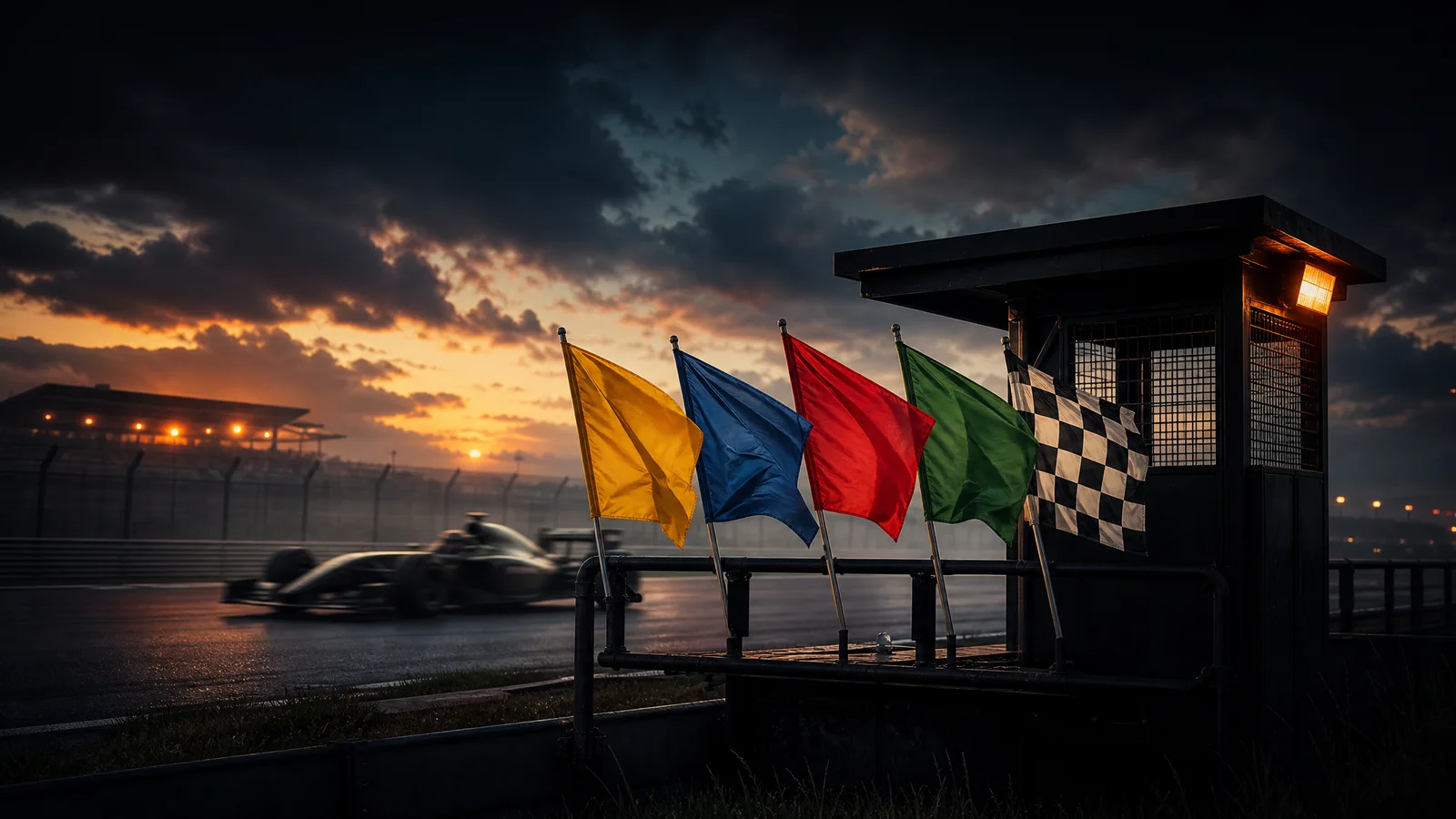
Formula 1 has eleven flag signals: ten flags plus the double yellow, when two are waved at once. Some warn of danger, some are meant for a single driver and others control the whole session. Most flags are shown by marshals at their posts around the track. The chequered flag and the three black flags are shown at the start/finish line, and the red flag both there and at every post.
The FIA light panels around the track mean the same as the flags. Drivers also have their own lights in the cockpit — red, blue and yellow — right in their line of sight.
- Green
- Yellow
- Double yellow
- Red
- Blue
- White
- Yellow and red striped
- Black and white
- Black with orange disc
- Black
- Chequered
| Flag | What it means | What the driver does |
|---|---|---|
| Yellow | Danger beside the track or partly on it | Slows down, doesn’t overtake, is ready to change line |
| Double yellow | The track is wholly or partly blocked, or marshals are working on it | Slows down a lot, doesn’t overtake, is ready to stop |
| Green | The danger is behind | Goes back to full speed |
| Red | The session has been stopped | Drives slowly to the pit lane, doesn’t overtake |
| Blue | A faster car is behind; in the race, it is about to lap you | Lets it through at the first opportunity |
| White | A much slower car on this part of the track | Expects a slow car ahead |
| Yellow with red stripes | Oil or water on the track, less grip | Drives more carefully |
| Black and white | Warning for unsporting behaviour | Doesn’t repeat the offence |
| Black with an orange circle | A dangerous problem with the car | Pits on the next lap |
| Black | The stewards’ order to stop | Pits the next time they reach the pit entry |
| Chequered | End of the session or the race | Completes the lap; after the race, heads to parc fermé |
Yellow flag: danger on this part of the track
The yellow flag warns of danger beside the track or partly on it: slow down, don’t overtake and be ready to change line. The stewards must be able to see that the driver braked earlier than usual or clearly cut their speed in that sector.
A double yellow means a marshal is waving two flags: the hazard wholly or partly blocks the track, or marshals are working on or next to it. Drivers must slow down significantly and be ready to stop. In qualifying and Sprint Qualifying, a lap on which the driver went through such a sector is deleted in every case.
Overtaking is banned from the first yellow flag until the green flag, which is shown at the post just after the incident. Green means the danger is behind and you can go flat out again. It is sometimes used to start a practice session, too.
Breaking the rule in qualifying costs grid places. That is what happened to Max Verstappen at the 2021 Qatar Grand Prix: he failed to respect double yellow flags after Turn 16. The stewards deleted that lap, gave him a five-place grid penalty and two penalty points: he started seventh instead of second and finished second.
The light panels in that section were not switched on, but the stewards pointed out that a flag means the same as a panel and that obeying the signal is the driver’s job. Back then the usual penalty for a double yellow was five places; under the FIA’s 2026 guidelines it is ten.
Red flag: the session is stopped
The red flag stops a practice session, qualifying or the race. It is waved at every post, orange lights come on at the start gantry, and all drivers slow down and return slowly to the pit lane. Overtaking is banned, and a lap completed after the red flag has been shown does not count.
In qualifying, the interrupted part is extended afterwards so that no track time is lost. In the race, the pit exit is closed and the cars queue up. The race clock keeps running: the stoppage is added to the two-hour limit, but that limit can never go beyond three hours from the start. During the stoppage, teams can change tyres and repair crash damage.
If the race is never restarted, the result is taken at the end of the penultimate lap before the lap on which it was stopped. That is how the Belgian Grand Prix on 29 August 2021 ended: it was stopped because of the weather, and the classification was drawn up after one lap — 6.88 km. Half points were awarded, and Verstappen got 12.5 for the win. How shortened races are scored in 2026 is covered in the points article.
Blue flag: let the faster car through
In the race, the blue flag is waved at a driver who is about to be lapped: they must let the other car through at the first opportunity. In practice and qualifying, blue means a faster car is right behind and about to overtake.
Drivers get a little leeway: under the FIA guidelines, the pass can happen on the next straight. Ignoring blue flags in the race usually costs a 5- or 10-second penalty or a drive-through.
At the pit exit, a stationary blue flag or a flashing blue light is shown when cars are approaching on the track.
White flag and the slippery-track flag
The white flag is waved when a much slower car is on that part of the track.
The yellow flag with red stripes is held still: there is oil or water ahead, and grip is reduced. It stays out for at least four laps unless the surface returns to normal sooner, and no green flag is needed after it.
Black flags: warning, repairs, stop
Three flags are meant for a single driver. They are held still together with a black board showing the car number in white.
- Black and white, split diagonally — a warning for unsporting behaviour or for something that will be penalised if repeated. It is shown only once. In the race, for example, it comes after the third time over the track limits; the fourth time and every time after that costs a five-second penalty.
- Black with an orange circle — the car has a problem that endangers the driver or others. The driver must pit on the next lap and may return once the technical delegate accepts the repair.
- Black — an order to stop in the pits the next time the driver reaches the pit entry. Only the stewards can make that call, the team is told at once, and if the driver does not obey, the flag is shown for no more than four laps in a row.
Under the FIA guidelines, a driver who ignores a black or a black-and-orange flag in the race is disqualified.
Chequered flag: the finish
The chequered flag marks the end of the session. In the race it is shown at the line as soon as the leader has covered the full distance, and it keeps waving until every car has crossed the line. After the finish, the cars go straight to parc fermé.
Sometimes the flag is shown too early by mistake. The race is then deemed to have ended when the leader last crossed the line before the signal. If the flag comes late, the result is still taken at the moment the race should have ended.
Safety car and VSC: flags, boards and panels
When the safety car comes out, yellow flags are waved and SC boards are shown at every post, and the light panels show SC. Drivers line up behind it no more than ten car lengths apart, and overtaking is banned.
The Virtual Safety Car works without a car on track: the panels show VSC, and drivers must cover each section of the lap no faster than a minimum time set by the FIA electronics. Overtaking is banned here too. Under both the VSC and the safety car, drivers may pit only to change tyres. When the VSC ends, the panels turn green.
How the safety car changes the course of a race is explained in the chapter “Flags, the safety car and penalties”.
Penalties for ignoring flags
Penalties are handed out by the stewards, and the FIA publishes guidelines with the usual penalties for 2026. They are a reference point: every case is judged on its merits, and the penalty can be different.
| Offence | Practice and qualifying | Race |
|---|---|---|
| Not slowing for yellow, or overtaking | 5 grid places | 10 seconds or a drive-through |
| The same under double yellow | 10 grid places | 10-second stop-and-go |
| Not slowing for red | 10 grid places | 10-second stop-and-go or a black flag |
| Not letting a car by under blue | Qualifying: treated as impeding, 3 grid places | 5 or 10 seconds or a drive-through |
| Ignoring a black or black-and-orange flag | Practice: start from the back of the grid; qualifying: disqualification from the session | Disqualification |
| Exceeding track limits | In qualifying the lap is deleted | 3rd time: black-and-white flag; 4th time on: 5 seconds |
For flag offences the stewards usually add penalty points as well — up to five, though ignoring blue flags in the race carries none. Twelve points within twelve months and the driver misses the next event. Other penalties are covered in the beginner’s chapter, and how flags work in qualifying in the qualifying article.
FAQ
What does the blue flag mean in F1?
In the race, it means you are about to be lapped: let the other car through at the first opportunity, usually on the next straight. In practice and qualifying, it means a faster car is behind you — don’t get in its way.
What is the difference between a yellow and a double yellow flag?
A single yellow means danger beside the track: slow down and don’t overtake. A double yellow means the track is blocked or marshals are working on it: slow down a lot and be ready to stop — and in qualifying that lap is deleted.
When is the red flag shown?
When the Race Director decides the session cannot go on — because of the weather, for example, as at Spa in 2021. Everyone drives slowly to the pit lane. The race is then either restarted or ended early; if it ends, the result is taken at the end of the penultimate lap before the stoppage.
Which flag starts the race?
None: the race is started by five red lights on the start gantry, and it begins when they go out. A marshal at the back of the grid has a flag in the start procedure too: they may wave green to tell the starter that every car is in place.
What does the black and white flag mean?
It is a warning to one driver, whose car number is shown on a board next to it. It is given for unsporting behaviour and, in the race, also for the third time over the track limits: every time after that costs five seconds.
Who decides which flag to show?
Danger signals are shown by marshals at their posts, and the red flag only on the Race Director’s order. The black flag is the stewards’ decision, while the black-and-white and black-and-orange flags are usually shown on the decision of race control.
Sources
- FIA International Sporting Code, Appendix H 2026 (23 June 2026): signals, Art. 2.5
- FIA 2026 F1 Regulations, Section B (Sporting), Issue 08, 5 August 2026
- FIA 2026 Formula 1 Penalty Guidelines, version 01
- FIA 2026 Formula 1 Driving Standards Guidelines, version 01, 26 February 2026
- FIA 2026 F1 Regulations, Section A, Issue 03, 25 June 2026
- FIA 2026 F1 Regulations, Section C (Technical), Issue 20, 5 August 2026
- FIA stewards’ decision, 2021 Qatar Grand Prix, document 42, 21 November 2021
- FIA final race classification, 2021 Belgian Grand Prix, document 43, 29 August 2021
- FIA statement on the 2021 Belgian Grand Prix, 29 August 2021
- f1db, the Formula 1 results database (CC BY 4.0)