The main difference: each team’s own car versus an identical one
In Formula 1 every team is a constructor: it designs the key parts of its car itself, above all the monocoque, and may not get them from a rival. In Formula 2 everyone has the same car — a Dallara with a Mecachrome engine. The teams get cars built by the series’ suppliers, and under the regulations they may not change anything beyond what is permitted.
In Formula 2 only what the regulations and the supplier’s manual allow may be changed: for example, the suspension settings and the choice among the specified front and rear wing configurations. The FIA Formula 2 Championship has existed since 2017: it replaced the GP2 series and is the last step before Formula 1. How the whole ladder works is explained in the article “How to become an F1 driver”.
F1 and F2 side by side
The comparison follows the 2026 FIA regulations of both series. The regulations don’t state Formula 2’s power, so that figure comes from the car page on the championship’s official website (checked in September 2026).
| What we compare | Formula 1 | Formula 2 |
|---|---|---|
| Car | Each team’s own | The same for everyone: a Dallara, in its current form since 2024 |
| Engine | 1.6-litre turbocharged V6 and an MGU-K electric motor of up to 350 kW | 3.4-litre turbocharged Mecachrome V6, no electric motor |
| Power | About 1,020 hp at peak — our conversion of the FIA’s estimate | 620 hp — from the championship website, 2026 |
| Minimum weight | 724 kg with the driver, without fuel or tyres | 793 kg with the driver and tyres, without fuel |
| Overtaking aid | No DRS since 2026: Straight Mode and Overtake Mode | DRS, if less than a second behind a rival |
| Tyres | Pirelli, 18-inch wheels | Pirelli, 18-inch wheels |
| Practice | Three one-hour sessions at a standard event | One, 45 minutes |
| Qualifying | One hour, in three parts | One 30-minute session |
| Races per event | One, over 305 km; plus a sprint at six events in 2026 | A sprint over 120 km and a feature race over 170 km |
| Pit stops | Two different tyre compounds compulsory in a dry race | One compulsory pit stop and both compounds in the feature race |
| Points for a win | 25 in the race, 8 in the sprint | 25 in the feature race, 10 in the sprint |
| Driver’s licence | FIA Super Licence | FIA International Grade A or B licence |
| Teams and cars in 2026 | 11 and 22 | 11 and 22 |
There is more on the Formula 1 car and engine in the articles on the 2026 car and the engine, and on what replaced DRS in the article on the 2026 rules.
How much faster is F1?
At the permanent circuits of 2026, by 9–12 seconds a lap. All 12 Formula 2 rounds up to the end of September 2026 were held at Formula 1 weekends, and six of them were at permanent circuits. Those are the six we compared: the Formula 2 pole was 9.4 to 11.9 seconds slower than the Formula 1 pole, or 11–15% of the lap time. The street circuit rounds — Melbourne, Miami, Montreal, Monaco, Madrid and Baku — are not included.
| 2026 round | F1 pole | F2 pole | Gap |
|---|---|---|---|
| Barcelona | 1:14.679, George Russell | 1:24.810, Rafael Câmara | 10.131 s |
| Austria | 1:06.113, George Russell | 1:15.544, Noel León | 9.431 s |
| Silverstone | 1:28.111, Kimi Antonelli | 1:39.690, Rafael Câmara | 11.579 s |
| Spa | 1:44.361, Kimi Antonelli | 1:56.306, Rafael Câmara | 11.945 s |
| Budapest | 1:17.207, Lando Norris | 1:28.896, Kush Maini | 11.689 s |
| Monza | 1:21.786, Pierre Gasly | 1:31.326, Rafael Câmara | 9.540 s |
The times come from the FIA’s final qualifying classifications, and the gaps are our own calculation. The two series qualify on different days of the weekend and the classifications don’t record the weather, so this is a guide rather than a like-for-like measurement. In seconds, Formula 2 lost least at the Red Bull Ring, which has the shortest lap time of the six, and most at Spa.
How an F2 weekend works
Formula 2 has two races at each event. Under the 2026 Sporting Regulations, the weekend runs like this:
- Friday: one 45-minute practice session and one 30-minute qualifying session.
- Saturday: the sprint race, over 120 km and no longer than 45 minutes. The top ten from qualifying start in reverse order, so pole in the sprint goes to the driver who qualified tenth.
- Sunday: the feature race, over 170 km and no longer than an hour, with the grid set by qualifying. It has one compulsory pit stop — not before the end of lap six, with at least two wheels changed — and in a dry race both tyre compounds must be used.
Each car gets five sets of dry tyres and three sets of wets per event. Feature race points are the same as in Formula 1: 25, 18, 15, 12, 10, 8, 6, 4, 2 and 1. In the sprint the top eight score 10, 8, 6, 5, 4, 3, 2 and 1. There are also two points for pole position for the feature race, and one for the fastest lap in each of the two races if the driver finishes in the top ten. How a Formula 1 weekend works is explained in the chapter “How a Grand Prix weekend works”.
How F2 leads to F1
Through Super Licence points. Under the 2026 edition of Appendix L, the top three in Formula 2 get 40 points each — exactly the number a Super Licence requires. No other series in the 2026 table gives that many for third place: the Formula 3 champion gets 30. The full table and the routes into Formula 1 that bypass Formula 2 are in the article on the Super Licence and the path to F1.
Drivers who reached Formula 1 through Formula 2 include Charles Leclerc, George Russell and Oscar Piastri. Four drivers stepped up from the 2024 Formula 2 season at once: Gabriel Bortoleto, Oliver Bearman, Kimi Antonelli and Isack Hadjar. In 2025 Lando Norris became the first Formula 2 graduate to win the World Championship.
Formula 2 teams are not Formula 1 teams. In 2026 the series has 11 teams of its own: Invicta, Rodin, Campos, ART, Hitech, MP, Trident, DAMS, PREMA, Van Amersfoort and AIX. Formula 2 races take place at Formula 1 events, and the series is run by the Formula 1 group under FIA rules.
Formula 3 and Formula 4
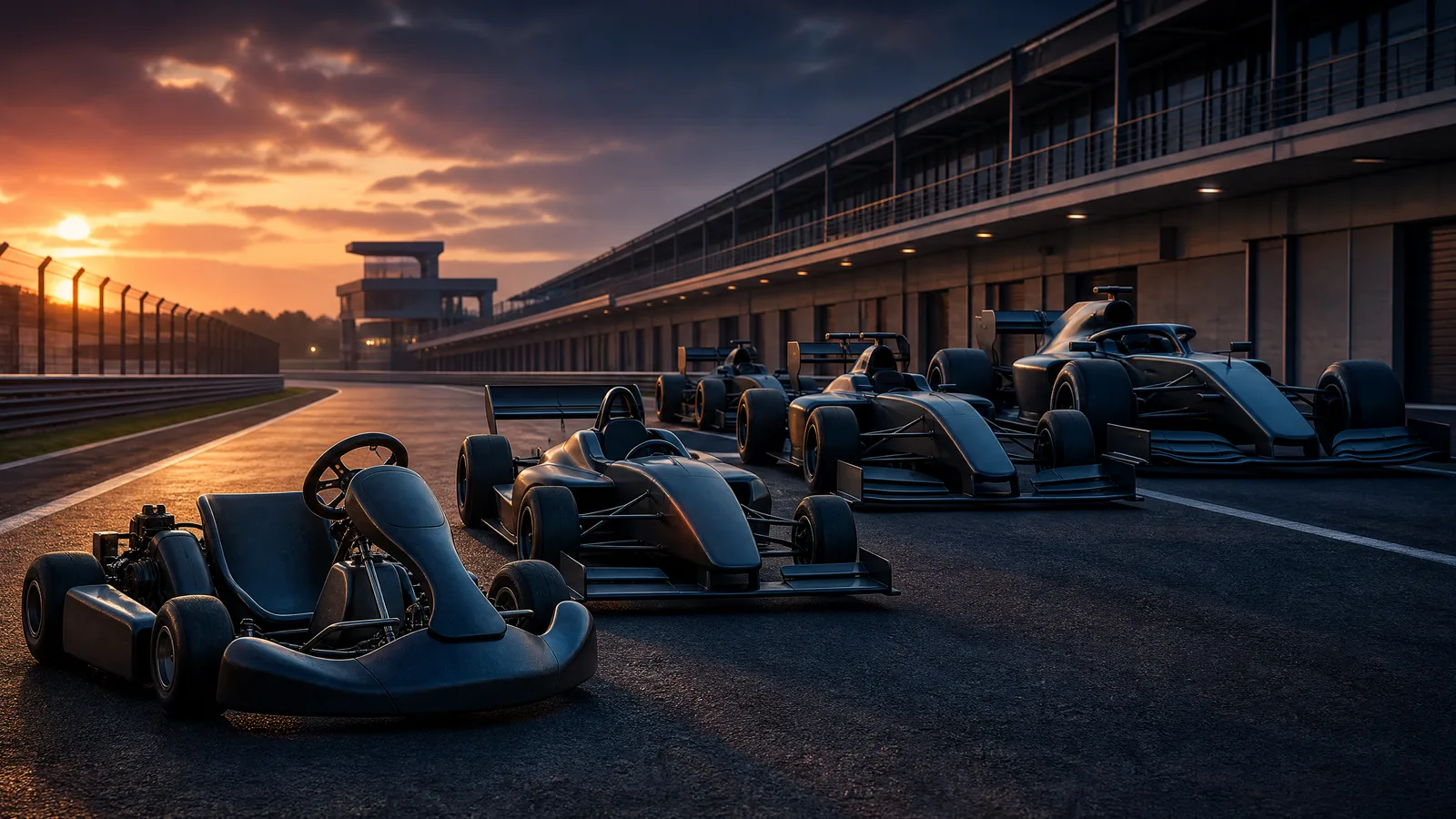
These are the rungs below. Formula 3 is also an international FIA championship with identical Dallara cars, but its engine has no turbo: 380 hp against Formula 2’s 620. Formula 4 is a set of national championships certified by the FIA. There were 13 of them in 2025, drivers can race from the age of 15, and the champion gets 12 Super Licence points.
| Series | Cars | Engine | Power | Wheels | Super Licence points for the 2026 title |
|---|---|---|---|---|---|
| Formula 2 | 22 identical Dallaras | 3.4-litre turbocharged V6 | 620 hp | 18-inch | 40 |
| Formula 3 | 30 identical Dallaras | 3.4-litre naturally aspirated V6 | 380 hp | 16-inch | 30 |
The minimum weight of a Formula 3 car is 729 kg without fuel, and it has DRS too. Formula 1 itself isn’t in the points table: to start a Formula 1 race, you already need a Super Licence.
FAQ
Which is faster, F1 or F2?
Formula 1. At the six permanent circuits where both series raced on the same weekend in 2026, the Formula 2 pole was 9.4–11.9 seconds slower than the Formula 1 pole — our calculation from FIA classifications.
How much horsepower does an F2 car have?
620 hp at 8,750 rpm, according to the car page on the championship’s official website (September 2026). The engine is a 3.4-litre turbocharged Mecachrome V6, with no electric motor.
Does F2 have DRS?
Yes. Under the 2026 Formula 2 regulations a driver may use DRS in the DRS zones if they are less than a second behind a rival at the detection point. Formula 1 has had no DRS since 2026.
How is Formula E different from F1?
Formula E is a championship for electric cars. Its first race was held in Beijing on 13 September 2014, and the series has had FIA World Championship status since the 2020/21 season. In the 2024/25 and 2025/26 seasons its cars produced up to 350 kW and weighed at least 859 kg with the driver. Under the 2026 table, the Formula E champion gets 30 Super Licence points.
Was there a Formula 2 before?
Yes. The FIA introduced a second formula back in 1948, and at the same time the top one became known as Formula 1 — see the article on the name. Today’s FIA Formula 2 has raced since 2017, replacing the GP2 series.
Sources
- FIA 2026 Formula 2 Technical Regulations, Issue 3, 23 February 2026
- FIA 2026 Formula 2 Sporting Regulations, V3, 24 June 2026
- FIA 2026 F1 Regulations, Section B (Sporting), Issue 08, 5 August 2026
- FIA 2026 F1 Regulations, Section C (Technical), Issue 20, 5 August 2026
- FIA International Sporting Code, Appendix L, edition of 23 June 2026
- FIA: final qualifying classification, 2026 Italian Grand Prix, document 50
- FIA: Formula 2 final qualifying classification, Monza 2026, document 42
- FIA: 2026 Formula 1 documents (qualifying classifications)
- FIA: 2026 Formula 2 documents (qualifying classifications)
- FIA Formula 2: the car and engine
- FIA Formula 2: about the championship
- FIA Formula 3: the car and engine
- Formula E: championship history