What “formula” means
A formula is a set of technical rules that a car must comply with to be allowed to race in its class. It lays down what the design may be, what engine is allowed and which parts are permitted. A car that doesn’t fit the formula doesn’t take the start.
In 2026 the FIA — the Fédération Internationale de l’Automobile — is responsible for the rules of Formula 1: the technical, sporting and financial regulations. How this works in practice is explained in the chapter “Teams, drivers and cars”.
Where the 1 comes from
The number shows rank: Formula 1 is the main, top formula. It didn’t get its number straight away.
- 1946. The FIA’s sporting commission approved a new main formula for Grands Prix: engines of up to 4.5 litres without forced induction or up to 1.5 litres with a supercharger. At first it was called Formula Internationale.
- 1948. The FIA added a second formula, for engines of up to 2 litres without forced induction or up to 500 cc with a supercharger. The old one became known as Formula I and the new one as Formula II.
- 1950. Formula 1 got its World Championship, and by the time it began the FIA had also introduced an international Formula III, for cars with engines of up to 500 cc.
A formula and a championship aren’t the same thing: in 1952 and 1953 the World Championship was run with Formula 2 cars.
When the first World Championship was held
The first World Championship was held in 1950. The first race was the British Grand Prix at Silverstone on 13 May 1950: Nino Farina won, and Alfa Romeo cars took the top three places. The details are on the page for that race.
The first season had seven races, including the Indianapolis 500. Points went to the top five — 8, 6, 4, 3 and 2 — plus one for the fastest lap. Farina became champion, as the 1950 season page shows. The Constructors’ Championship was added in 1958, and every champion since the first season is listed in the article “F1 champions by year”.
The championship’s official name
The full name is the FIA Formula One World Championship. It has two titles: world champion among drivers and among constructors, meaning the teams. The rounds of the championship are Grands Prix, and the FIA regulations call them exactly that: FIA Formula One Grand Prix competitions.
How F1 differs from Formula 2, Formula 3 and Formula E
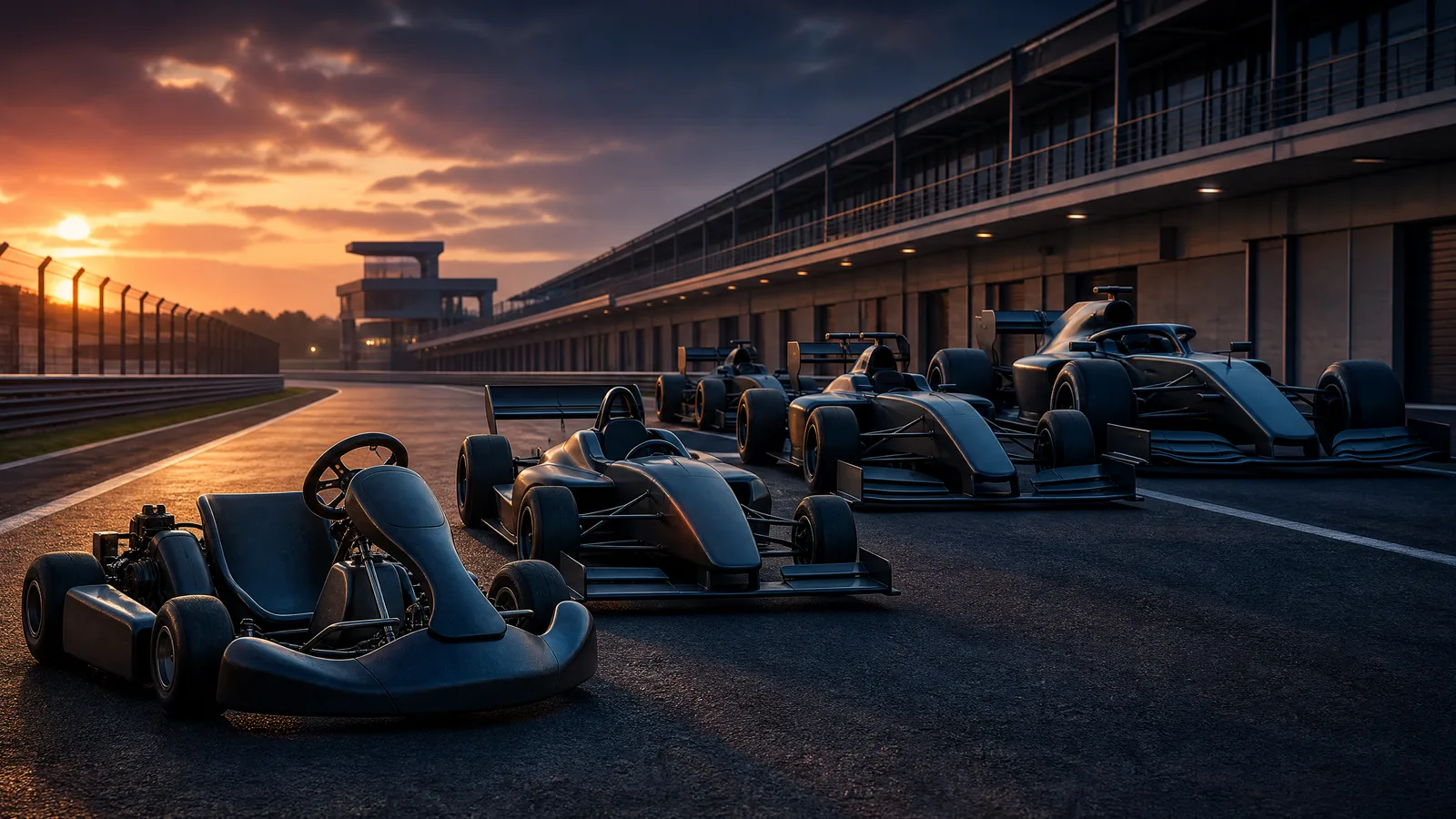
The main difference is the cars. In Formula 1 each team must design the key parts of its car itself, above all the monocoque, and can’t buy them from a rival; that is why the teams are called constructors. In Formula 2 and Formula 3 everyone has the same car.
| Series | Cars | Engine | Status |
|---|---|---|---|
| Formula 1 | Each team has its own | 1.6-litre turbocharged V6 and an electric motor of up to 350 kW, from 2026 | FIA World Championship since 1950 |
| FIA Formula 2 | Identical, Dallara | 3.4-litre turbocharged Mecachrome V6, 620 hp | FIA championship since 2017, replaced GP2 |
| FIA Formula 3 | Identical, Dallara | 3.4-litre naturally aspirated Mecachrome V6, 380 hp | FIA championship since 2019 |
| Formula E | Electric cars | Electric motor | First race in 2014; FIA World Championship since the 2020–21 season |
From 2026 the power of a Formula 1 power unit is split roughly equally between the internal combustion engine and the electric motor. Formula 2 and Formula 3 are steps for young drivers on the way to Formula 1; how the whole ladder works is explained in the article “How to become an F1 driver”. A detailed comparison of Formula 1 and Formula 2 is in a separate article.
Who runs Formula 1
Formula 1 is run by two parties with different roles. The FIA is responsible for the sporting organisation and the rules, while the commercial rights are managed by a company, Formula One World Championship Limited.
- The FIA, the Fédération Internationale de l’Automobile, was founded in 1904 as the AIACR and has had its present name since 1946. Under the 2026 regulations the championship is the property of the FIA, and at each event the stewards enforce the rules.
- The Commercial Rights Holder is Formula One World Championship Limited. The FIA has granted it the exclusive right to the commercial side of the championship, and it appoints the promoter of each event. Since 23 January 2017 the Formula 1 group has been owned by Liberty Media.
- The Concorde Agreement is an agreement between the FIA, Formula 1 and the teams. The ninth such agreement, signed by all 11 teams, runs until 2030.
Why is F1 called “the pinnacle of motorsport”?
Because the FIA says so itself: in the 2026 regulations, the first objective of the rules is to maintain the championship as the pinnacle of motorsport. In Russian-language writing about racing, Formula 1 also has an unofficial nickname, “the royal races”, but no FIA document gives it any “royal” status.
FAQ
What is Formula 1, in simple terms?
A world championship of circuit races for single-seater cars built to a single set of FIA rules. A season is made up of rounds — Grands Prix in different countries — and the points go into two championships, one for drivers and one for teams. How a race weekend works is explained in the chapter “How a Grand Prix weekend works”.
When did Formula 1 start?
The Formula 1 rules were approved in 1946, and the World Championship has been held since 1950: the first race took place at Silverstone on 13 May 1950.
How is Formula 1 different from Formula 2?
In Formula 1 each team designs the key parts of its own car, while in Formula 2 everyone drives the same Dallara car with the same engine. Formula 2 is the last step before Formula 1, and Lando Norris, the 2025 world champion, became the first of its graduates to win the Formula 1 title.
Who owns Formula 1?
The championship is the property of the FIA. The FIA has granted the exclusive right to its commercial side to Formula One World Championship Limited, and the Formula 1 group has been owned by Liberty Media since 2017.
Sources
- Formula 1: “Why is it called Formula 1 — and 12 other questions” by David Tremayne, 13 May 2020
- Formula 1: “Everything you need to know about Formula 1”
- Motor Sport, February 1948: Formula I and the new Formula II
- Motor Sport, January 1950: the international Formula III
- FIA 2026 F1 Regulations, Section A, Issue 03, 25 June 2026
- FIA 2026 F1 Regulations, Section C (Technical), Issue 20, 5 August 2026
- FIA: the 2026 Formula 1 regulations and the power unit, 6 June 2024
- FIA: the federation’s 120th anniversary, 21 June 2024
- Formula 1: the 1952 and 1953 championships run with Formula 2 cars (Edd Straw, 10 August 2023)
- FIA Formula 2: about the championship
- FIA Formula 2: the car and engine
- FIA Formula 3: about the championship
- FIA Formula 3: the car and engine
- Formula E: championship history
- Liberty Media completes its acquisition of Formula 1, 23 January 2017
- Formula 1: the 2026–2030 Concorde Agreement is signed, 12 December 2025
- f1db, the Formula 1 results database (CC BY 4.0)