What you need to start an F1 race
Two things: a Super Licence from the FIA and a seat with a team. The FIA issues the Super Licence under Article 13 of Appendix L to the International Sporting Code; everything below follows the edition of 23 June 2026. To get one for the first time, a driver generally has to:
- hold a valid FIA International Grade A licence;
- be at least 18 at the start of their first F1 event — in exceptional cases the FIA grants it at 17 to a driver who has consistently shown outstanding ability and maturity in single-seaters;
- have completed at least 80% of each of two full seasons in single-seater championships from the FIA points table;
- have scored 40 Super Licence points: for a 2026 application the FIA counts either 2023–2025 or 2024–2026, whichever total is higher;
- answer questions on the key points of the International Sporting Code and the F1 Sporting Regulations.
A Super Licence is valid until the end of the year in which it was issued, so drivers apply every season. For the first 12 months after their first race, a newcomer is on probation.
The path from karting to F1
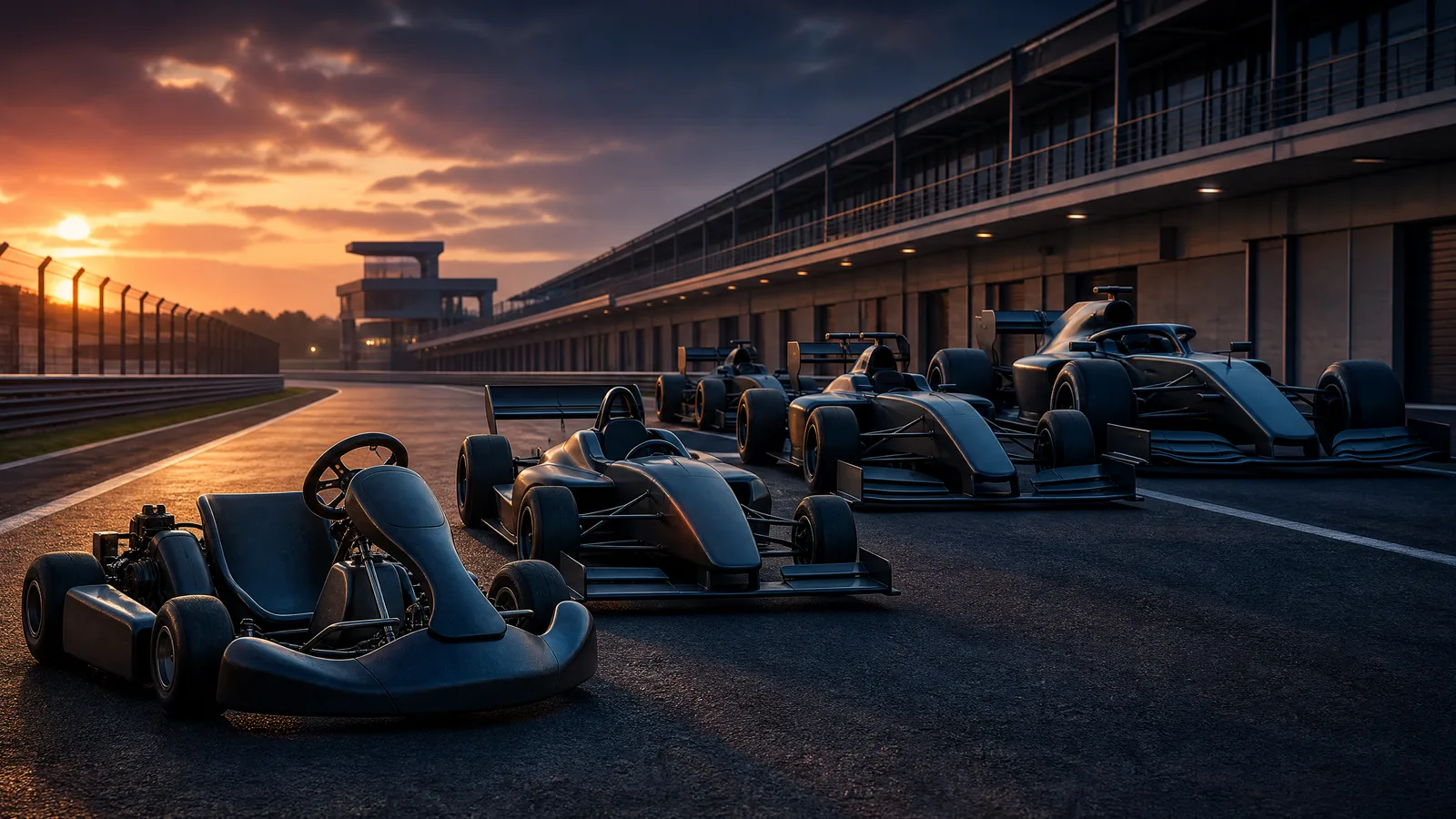
The FIA describes the path as a ladder: karting, Formula 4, regional formula, Formula 3 and Formula 2, then Formula 1. Each rung has its own entry requirements, and the higher the rung, the more Super Licence points it offers.
- Karting is the bottom rung. Only FIA world and continental championships score Super Licence points, no more than 12 in total, and they are valid for five years.
- Formula 4 is the first step in racing cars. These are national championships certified by the FIA — there were 13 of them in 2025 — and drivers must be at least 15.
- Regional formula is the step between Formula 4 and Formula 3. In the European series, FRECA, drivers must be at least 16.
- FIA Formula 3 is an international championship for 30 identical Dallara cars.
- FIA Formula 2 is the last step: the top three in the final standings score all the Super Licence points they need in one go.
- Formula 1: first Friday practice sessions and tests, then a race seat.
The path doesn’t have to be a straight line: the rules require points, not a particular series. Points also come from IndyCar, Formula E, Japan’s Super Formula and the World Endurance Championship. How drivers of the 2026 season climbed the ladder is told in their biographies — for example those of Kimi Antonelli and Arvid Lindblad.
How to score Super Licence points: the FIA table for 2026
Points are awarded for the final position in a championship, not for individual races: the higher the series, the more points. The table shows the main series from Supplement 1 to Appendix L in the edition of 23 June 2026; it applies to championships that finished in 2026.
| Championship | Points for 1st to 10th |
|---|---|
| FIA Formula 2 | 40, 40, 40, 30, 20, 10, 8, 6, 4, 3 |
| IndyCar | 40, 30, 25, 20, 15, 10, 8, 6, 3, 1 |
| FIA Formula 3 | 30, 25, 20, 15, 12, 9, 7, 5, 3, 2 |
| Formula E | 30, 25, 20, 10, 8, 6, 4, 3, 2, 1 |
| World Endurance Championship, Hypercar class | 30, 24, 20, 16, 12, 10, 8, 6, 4, 2 |
| Super Formula (Japan) | 30, 25, 20, 15, 12, 9, 7, 5, 3, 2 |
| FRECA, the Formula Regional European Championship | 25, 20, 15, 10, 7, 5, 3, 2, 1, 0 |
| Formula Regional in the Americas, Japan and India | 18, 14, 12, 10, 6, 4, 3, 2, 1, 0 |
| Euroformula Open | 15, 12, 10, 7, 5, 3, 2, 1, 0, 0 |
| FIA-certified Formula 4 | 12, 10, 7, 5, 3, 2, 1, 0, 0, 0 |
| F1 Academy | 10, 7, 5, 3, 1, 0, 0, 0, 0, 0 |
| Karting World Championship, senior class | 4, 3, 2, 1, 0, 0, 0, 0, 0, 0 |
According to the table, only two series pay the full 40 in a single season: Formula 2 to its top three and IndyCar to its champion. Everywhere else, the points build up over two or three years. A few more counting rules:
- in any calendar year, results from no more than two championships count, and the second must start after the first has finished;
- if fewer than 16 cars start the first race of an event, the points for the whole championship are cut by 10% for each missing driver;
- a full season without penalty points in FIA championships adds two points;
- a Free Practice Only Super Licence holder gets one point for each F1 event where they covered at least 100 km in practice without penalty points, up to 10 in total.
How old do you have to be?
At least 18 at the start of your first event, and since 2024 the FIA can also grant a Super Licence to a 17-year-old. The age limit arrived together with the points system: in December 2014 the FIA World Motor Sport Council approved both for the Super Licence from 2016.
Max Verstappen got in just before that: he made his debut in March 2015, aged 17 years and 166 days. That is the youngest start in championship history, and under the 2026 rules it can only be beaten through the exception for 17-year-olds. The FIA granted that exception to Arvid Lindblad in June 2025, but he was already 18 when he made his race debut.
The youngest debutants according to f1db (up to 2026):
| Driver | First start | Team | Age |
|---|---|---|---|
| Max Verstappen | 2015 Australian Grand Prix | Toro Rosso | 17 years 166 days |
| Lance Stroll | 2017 Australian Grand Prix | Williams | 18 years 148 days |
| Kimi Antonelli | 2025 Australian Grand Prix | Mercedes | 18 years 203 days |
| Arvid Lindblad | 2026 Australian Grand Prix | Racing Bulls | 18 years 212 days |
| Oliver Bearman | 2024 Saudi Arabian Grand Prix | Ferrari | 18 years 306 days |
How newcomers get into an F1 car
Through Friday practice and tests. Under the 2026 Sporting Regulations (Article B1.7.3), at two events of the season each team must hand a practice session to a newcomer — in each of its two cars. A newcomer here means a driver who has taken part in no more than two championship races. What happens in practice is explained in the chapter “How a Grand Prix weekend works”.
There is a separate licence for these outings, the Free Practice Only Super Licence. A first application in 2026 requires six FIA Formula 2 events or 25 points, answers to questions on the rules and 300 km in a Formula 1 car. Another chance is the one-day test after the final round: one car from each team is reserved there for young drivers with a Grade A licence and no more than two championship races.
The next step is a seat as a reserve driver, who stands in for a race driver and works on the simulator. The Russians who have driven in Friday practice are covered in the article “Russian F1 drivers”.
How much does it cost to become an F1 driver?
We found no reliable official figures for what a season costs a driver in 2026, so there is only one figure here. When the FIA launched Formula 4 in 2013, it set a target: a season of 21–24 races should cost no more than about €100,000. That was the FIA’s benchmark when the series was launched, not today’s price.
Many drivers on the 2026 grid came through teams’ young driver programmes — you can see this in their biographies on the driver pages.
FAQ
Can you get into F1 without racing in Formula 2?
Yes: the Super Licence is awarded for points, and the rules don’t say in which series you have to score them. Under the 2026 table only the top three in Formula 2 and the IndyCar champion score 40 points in a single season, but points can be collected over three years in different championships.
Do you need a driving licence to get a Super Licence?
No. The FIA removed this requirement from Appendix L in the edition of 11 June 2024; the exception for 17-year-olds was added at the same time.
Is the 300 km test compulsory?
Under the 2026 rules, not if you get the Super Licence with 40 points. The test is for drivers who qualify by other routes. These are a previous Super Licence, or an FIA decision when a driver has at least 30 points but circumstances beyond their control stopped them scoring the rest. It is also required for the Free Practice Only Super Licence. The distance is at least 300 km at racing speed, over no more than two days and no earlier than 180 days before the application.
How many points does winning Formula 2 give?
In 2026 the FIA Formula 2 title is worth 40 Super Licence points — the same as second and third place, and enough on its own. Fourth place in the same year pays 30.
Sources
- FIA International Sporting Code, Appendix L, edition of 23 June 2026 (Chapter I, Art. 13; Supplement 1)
- FIA 2026 F1 Regulations, Section B (Sporting), Issue 08, 5 August 2026
- FIA International Sporting Code, Appendix L, edition of 11 June 2024 (changes to Art. 13.1)
- FIA World Motor Sport Council decisions, 3 December 2014
- FIA World Motor Sport Council decisions, 10 June 2025
- FIA: the single-seater pathway, 13 March 2025
- FIA 2026 FRECA Sporting Regulations, V5, 23 June 2026
- FIA Formula 3: the car and engine
- FIA Formula 4 booklet, first edition, 21 June 2013
- f1db, the Formula 1 results database (CC BY 4.0)