How does an F1 race start?
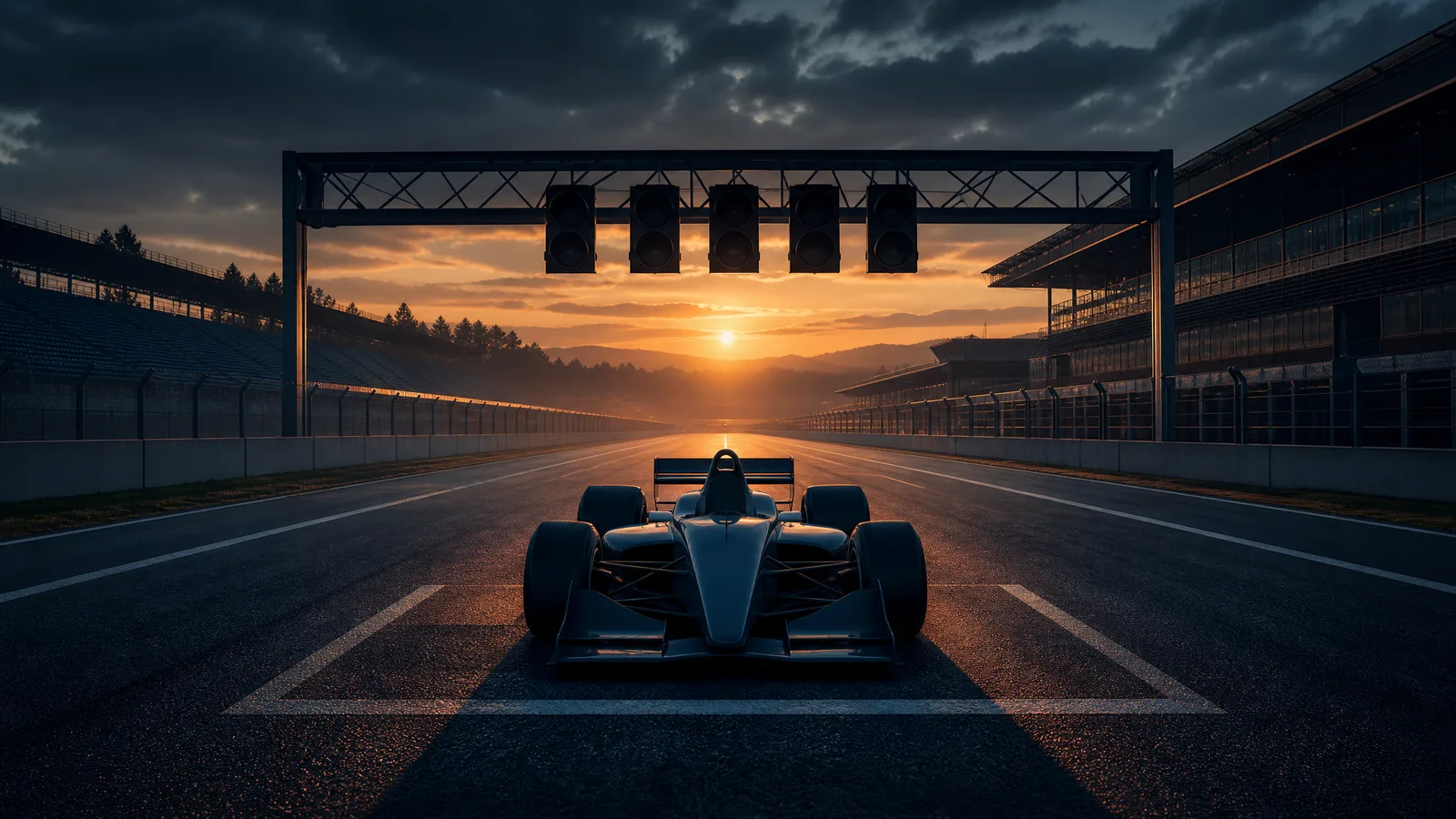
With a standing start. The cars sit on the starting grid under the start gantry with its lights, and the race begins when all five red lights go out. Before that come more than 40 minutes of preparation: reconnaissance laps, a countdown of signals and the formation lap. A rolling start only happens after laps behind the safety car; there is more on that at the end.
The grid is set by qualifying and penalties. The cars are staggered, with 16 metres between rows; who starts first and why is explained in the pole position article. What follows is the start procedure under the 2026 Sporting Regulations.
What happens before the formation lap?
Forty minutes before the formation lap, the pit lane exit opens for 10 minutes. Drivers do a reconnaissance lap, and anyone who wants to do several drives through the pit lane at greatly reduced speed between them. Then the cars line up on the grid in starting order and switch off their engines. No later than 16 minutes before the formation lap, all the drivers must be at the front of the grid for the national anthem.
Signals with an audible warning are shown 10, 5, 3 and 1 minute and 15 seconds before the formation lap:
| When | What happens |
|---|---|
| 10 minutes before | Everyone except drivers, officials and team technical staff leaves the grid |
| 5 minutes before | Wheels must be fitted, tyre blankets are switched off and mechanics start to leave |
| 3 minutes before | No more than 16 people from each team remain on the grid |
| 1 minute before | Engines are started; mechanics must leave before the 15-second signal |
| 15 seconds before | No mechanics and none of their equipment left on the grid |
| Start of the lap | The green lights come on and the formation lap begins |
If the Race Director delays the start before the formation lap has begun, the orange lights on the start gantry are switched on and a DELAYED START board is displayed. The countdown then starts again from the 10-minute signal.
Before a sprint everything is shorter: the pit lane exit opens 30 minutes before, for 5 minutes, and only one reconnaissance lap is allowed.
The formation lap
When the green lights come on, the cars move off behind the driver on pole. Until they pass the pole position slot, everyone keeps to the pit lane speed limit, and after that they run in a column as tight as possible.
Practice starts are not allowed on this lap. Overtaking is only permitted if a car is delayed and the others can’t avoid passing it without holding everyone up. Even then, drivers may only overtake to restore the starting order. A delayed driver who hasn’t got their place back by the first safety car line must enter the pit lane and start from the end of it.
At the end of the lap each car stops in its own grid slot, and the engines stay running. Cars starting from the pit lane also do the formation lap. They leave once the whole column has passed the pit exit, and return to the pit lane at the end of the lap.
The start lights
Once all the cars have stopped, in 2026 the grid panels first flash blue for five seconds and the start gantry shows the message Pre-Start. According to Formula 1, the FIA tried this signal out at pre-season testing in Bahrain. From the first round, the Australian Grand Prix, it has been written into the FIA Race Director’s notes for each event.
Formula 1 explains why it is needed. The 2026 engines no longer have the MGU-H, which used to help spin the turbo up quickly. To have full power at the start, the turbo has to be spinning at full speed the moment the lights go out, and the driver needs time to build up the revs. How the 2026 engine differs from the old one is explained in the engine article.
Then the five red lights come on, one per second. The regulations don’t set how long the pause after the fifth light lasts: that is up to the permanent starter appointed by the FIA. When all the red lights go out, the race has started.
Overtake Mode is disabled at the start: it is only enabled once the leader crosses the detection line for the first time.
What counts as a jump start?
A car moving after the third red light has come on and before all the lights have gone out. There are two more requirements. At the moment of the start, the front tyres must be inside the lines of the car’s grid slot, at the front and sides. And the car must be placed so that the transponder can detect when it moves off. The term in brief is in the glossary.
The stewards decide the penalty: for a jump start or an incorrect grid position, 5 or 10 seconds, a drive-through or a 10-second stop-and-go. Under the FIA guidelines the penalty is mandatory, and its size depends on how big the offence is. The other F1 penalties are collected in the penalties article.
What if something goes wrong?
If a car can’t move off the grid after the formation lap has begun, the driver raises their hands above their head. The marshals by that row wave yellow flags and/or switch on the yellow panel. When the Race Director decides it is safe, the marshals push the car by the quickest route into the pit lane. If it can be started there, the driver joins the race from the pit lane after the start.
If a problem puts the start at risk, the Race Director has two options:
| What | Aborted start | Extra formation lap |
|---|---|---|
| Signal | Orange lights and an ABORTED START board | Orange lights and an EXTRA FORMATION LAP board, then green lights 2 seconds later |
| What happens next | Mechanics return to the grid, and the countdown starts again from the 10-minute signal | Everyone goes straight out on another formation lap |
| The driver who caused it | Starts from the pit lane | Starts from the pit lane |
| Race distance | One lap shorter for each aborted start | One lap shorter for each extra formation lap |
However many times the formation lap is repeated, and however much the distance is cut, the race still counts for the championship.
The usual penalties for offences before the start are set out in the FIA’s 2026 penalty guidelines:
| Offence | Usual penalty |
|---|---|
| Not all wheels fitted at the 5-minute signal | 10-second stop-and-go |
| Mechanics touching the car on the grid after the 15-second signal | Pit lane start |
| Failing to regain position on the formation lap and not entering the pit lane | 10-second stop-and-go |
| The driver who caused an aborted start doesn’t start from the pit lane | 10-second stop-and-go |
| Burnouts or bite point checks in the pit lane during the reconnaissance laps | 5-second penalty |
Starting from the pit lane
A driver starts from the pit lane if:
- the team broke the parc fermé rules;
- the car was still in the pit lane when the exit closed after the reconnaissance laps;
- mechanics touched the car on the grid after the 15-second signal;
- the car was moved from the grid to the pit lane or the garage before the formation lap;
- the driver didn’t get their place back on the formation lap;
- the driver caused an aborted start or an extra formation lap;
- the team broke the curfew for its staff beyond the exceptions it is allowed, in which case both drivers start from the pit lane.
And a car that didn’t reach the grid under its own power can no longer start from the grid.
Pit lane starters queue at the exit. After the start, the exit opens once all the cars on track have passed it for the first time, and only then do these drivers join the race. A driver who has to start from the pit lane but doesn’t gets a 10-second stop-and-go.
Starting behind the safety car
If track conditions aren’t suitable for a start, the formation laps are run behind the safety car. If the Race Director makes wet-weather tyres compulsory for everyone, the start behind the safety car is announced at the 10-minute signal; if not, at the 5-minute signal.
When conditions allow, the Race Director chooses how to start:
- standing start — the safety car goes into the pits, the cars line up on the grid, and the normal procedure with the lights follows;
- rolling start — the safety car goes into the pits, a green flag is shown at the line, and the race starts when the leader crosses that line; nobody may overtake before it.
The race distance is cut for the formation laps behind the safety car; there is more in the race duration article. What else changes with the safety car out is covered in the safety car article.
FAQ
How does an F1 race start?
With a standing start. After the formation lap the cars stop in their grid slots, and the five red lights come on one per second and go out all at once: that is the moment the race begins. In 2026 blue panels also flash for five seconds before the lights.
How long after the fifth light do the lights go out?
There is no set time: the pause after the fifth light is chosen by the permanent starter appointed by the FIA. Between the lights themselves there is exactly one second.
What do the blue lights at the start mean?
They are the 2026 pre-start signal: the grid panels flash blue for five seconds, the gantry shows Pre-Start, and only then do the red lights come on. The time lets drivers build up the revs and spin up the turbo.
What do the orange lights at the start mean?
That the start is being delayed or aborted. A board is shown with them: DELAYED START means the start is delayed, ABORTED START that it has been aborted, and EXTRA FORMATION LAP that there will be another formation lap.
What is the penalty for a jump start?
The stewards give 5 or 10 seconds, a drive-through or a 10-second stop-and-go, depending on how big the offence is. Under the FIA’s 2026 guidelines, the penalty is mandatory.
What is the difference between a standing start and a rolling start?
In a standing start the cars are stationary on the grid and go on the lights. In a rolling start, which follows laps behind the safety car, the cars are already moving in a column. The race begins when the leader crosses the start line after the safety car has come in.
Sources
- FIA 2026 F1 Regulations, Section B (Sporting), Art. B5.1–B5.11, Issue 08, 5 August 2026
- FIA: Race Director’s Competition Notes, 2026 Australian Grand Prix, document 8, 5 March 2026
- FIA: Race Director’s Competition Notes, 2026 Azerbaijan Grand Prix, document 56, 26 September 2026
- FIA 2026 Formula 1 Penalty Guidelines, version 01
- Formula 1: why race starts are different in 2026, 3 March 2026