How long does an F1 race last?
Usually about an hour and a half. In 2025, 20 of the 24 races took between 1 h 20 min and 1 h 40 min, and half of them were over within 1 h 32 min. The quickest was Monza, at 1 h 13 min. The longest was Australia, at 1 h 42 min: changeable weather meant part of that race was run on intermediates.
2026 looks much the same: half of the first 14 races of the season were over within 1 h 33 min.
Race time runs from the start to the leader’s finish. The formation lap before the start isn’t part of the race distance.
How many laps are in an F1 race?
The regulations take the smallest whole number of laps that adds up to more than 305 km, so the longer the lap, the fewer laps there are. The exception is Monaco, where the distance only has to exceed 260 km.
| Circuit | Lap length | Laps in 2026 |
|---|---|---|
| Spa-Francorchamps | 7.004 km | 44 |
| Las Vegas | 6.201 km | 50 |
| Baku | 6.003 km | 51 |
| Silverstone | 5.891 km | 52 |
| Monza | 5.793 km | 53 |
| Zandvoort | 4.259 km | 72 |
| Monaco | 3.337 km | 78 |
You can work it out yourself: divide 305 by the lap length and round up. For Spa, 305 ÷ 7.004 = 43.5, so 44 laps. For Monaco, 260 ÷ 3.337 = 77.9, so 78.
The two-hour rule
If the leader hasn’t covered the distance two hours after the start, they get the chequered flag at the end of the lap after the one on which the two hours ran out. So a race can go slightly over two hours — but it never runs beyond the scheduled distance.
That is how the 2022 Singapore Grand Prix ended. According to FIA timing, the two hours ran out while Sergio Pérez was on lap 58, and he took the flag at the end of lap 59 — two laps short of the scheduled 61. The race was never red-flagged: it was the two-hour limit that ended it.
What makes a race longer
Laps behind the safety car and under the Virtual Safety Car count towards the race distance, but they are driven slowly. So a race with several safety car periods can run into the two-hour limit.
If the race is stopped with a red flag, the stoppage is added to the two hours, but the limit can never go beyond three hours from the start. When it runs out, the rule is the same: the leader finishes the lap in progress plus one more. If the race is never resumed, the result is taken at the end of the penultimate lap before the lap on which it was stopped — there is more in the flags article.
The three-hour limit came into play at the 2022 Japanese Grand Prix. The race was red-flagged and resumed after a long stoppage. According to FIA timing, the three hours ran out while Max Verstappen was on lap 28. The chequered flag came at the end of that same lap: 28 laps of 53, in 3 h 1 min 44 s. The regulations have explicitly required one more lap after the extended limit only since 2023. How many points such races pay is explained in the points article.
When the distance is cut in advance
Sometimes the scheduled number of laps changes before the start:
- an aborted start — the race is shortened by one lap for each such procedure;
- a start behind the safety car — if the formation laps were run behind the safety car, the distance is cut by the number of those laps minus one.
For 2027 the FIA has already approved one more exception. It will be able to shorten any race in advance by up to four laps, telling the teams no later than four weeks before the event.
The longest and shortest races
We count every World Championship race from 1950 up to the Azerbaijan Grand Prix on 26 September 2026, using f1db data. That includes the Indianapolis 500, which counted towards the championship from 1950 to 1960.
| Record | Race | Figure |
|---|---|---|
| Longest by time | 2011 Canadian Grand Prix | 4 h 4 min 39 s |
| Shortest by time | 2021 Belgian Grand Prix | 3 min 27 s, one lap |
| Fastest full race distance | 2025 Italian Grand Prix | 1 h 13 min 24 s |
| Longest by distance | Indianapolis 500, 1950–1960 | 804.672 km |
| Longest by distance without Indianapolis | 1951 French Grand Prix | 601.755 km, 77 laps |
| Shortest by distance | 2021 Belgian Grand Prix | 6.88 km |
The 2011 Canadian Grand Prix was stopped on lap 25 because of torrential rain, and the stoppage lasted more than two hours. Jenson Button won. Under the 2026 rules a race can’t go on that long: stoppage included, the limit is three hours.
The 2021 Belgian Grand Prix was never resumed because of the weather, and a single lap went into the classification. The 1951 French Grand Prix was held at Reims: 77 laps of 7.815 km.
How long does a sprint last?
A sprint is about a third of a race: its distance is the smallest number of laps that exceeds 100 km. The time limit is one hour, or an hour and a half at most with a red-flag stoppage. The first five sprints of 2026 took between 26 and 34 minutes. There is more in the sprint article.
What happens before the start
The race itself is only part of the day’s programme at the track:
- Forty minutes before the formation lap the pit exit opens: drivers do a lap of the track and line up on the grid. The pit exit closes 10 minutes later.
- Signals are shown 10, 5, 3 and 1 minutes and 15 seconds before the formation lap, each with an audible warning, and the teams gradually leave the grid.
- On the formation lap drivers warm up their tyres and brakes, then take their places again.
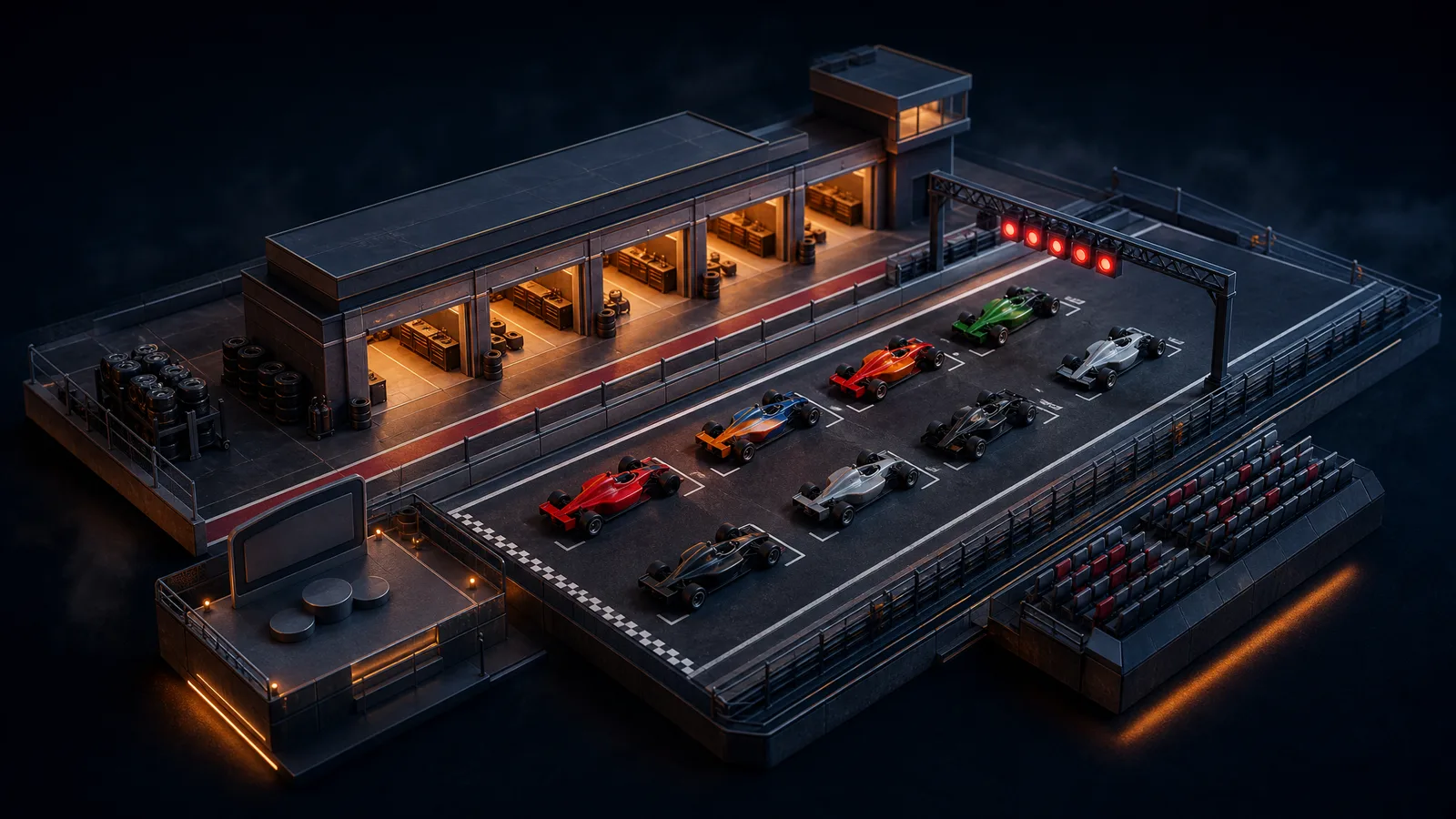
- Five red lights go out — the race has started, and the race clock is running.
- The leader takes the chequered flag, and all the cars head to parc fermé.
FAQ
How many hours does an F1 race last?
Usually about an hour and a half. In 2025 half the races were over within 1 h 32 min; the shortest took 1 h 13 min at Monza, and the longest 1 h 42 min in Australia.
How many laps are in an F1 race?
Enough for the distance to exceed 305 km, so the number depends on the length of the circuit. In 2026 Spa has the fewest laps, 44, and Monaco the most, 78.
How many kilometres is an F1 race?
Just over 305 km, or just over 260 km in Monaco. A sprint is just over 100 km.
Can an F1 race last more than two hours?
Yes. After two hours the leader finishes the lap in progress plus one more. And if the race was red-flagged, the stoppage extends the limit, but to no more than three hours from the start.
What was the longest F1 race?
The 2011 Canadian Grand Prix: 4 hours 4 minutes 39 seconds, including a stoppage of more than two hours because of torrential rain.
What was the shortest F1 race?
The 2021 Belgian Grand Prix: it was never resumed because of the weather, and a single lap went into the classification — 6.88 km in 3 minutes 27 seconds.
Why is the Monaco race shorter?
The regulations say so: in Monaco the distance is the smallest number of laps that exceeds 260 km, not 305. That means 78 laps of 3.337 km.
Sources
- FIA 2026 F1 Regulations, Section B (Sporting), Art. B2.3, B2.5, B5 and Appendix B5, Issue 08, 5 August 2026
- f1db, the Formula 1 results database (CC BY 4.0)
- FIA final race classification, 2022 Singapore Grand Prix, document 58, 3 October 2022
- FIA Race Lap Analysis, 2022 Singapore Grand Prix
- FIA final race classification, 2022 Japanese Grand Prix, document 48, 9 October 2022
- FIA Race Lap Analysis, 2022 Japanese Grand Prix
- FIA 2022 Formula 1 Sporting Regulations, Issue 8, 19 July 2022, Art. 5.4
- FIA 2023 Formula 1 Sporting Regulations, Issue 4, 22 February 2023, Art. 5.5
- FIA final race classification, 2021 Belgian Grand Prix, document 43, 29 August 2021
- Formula 1: the 2011 Canadian Grand Prix, the longest race, 12 June 2023
- Pirelli: compounds for the first three Grands Prix of 2026 and a look back at Australia 2025, 15 December 2025
- Jolpica (Ergast): 2026 sprint results